
Klaviyo
Klaviyo Flow Audit Using AI: The 30-Minute Revenue Recovery Loop
Date
September 01, 2026
Author
Igor Cerjan
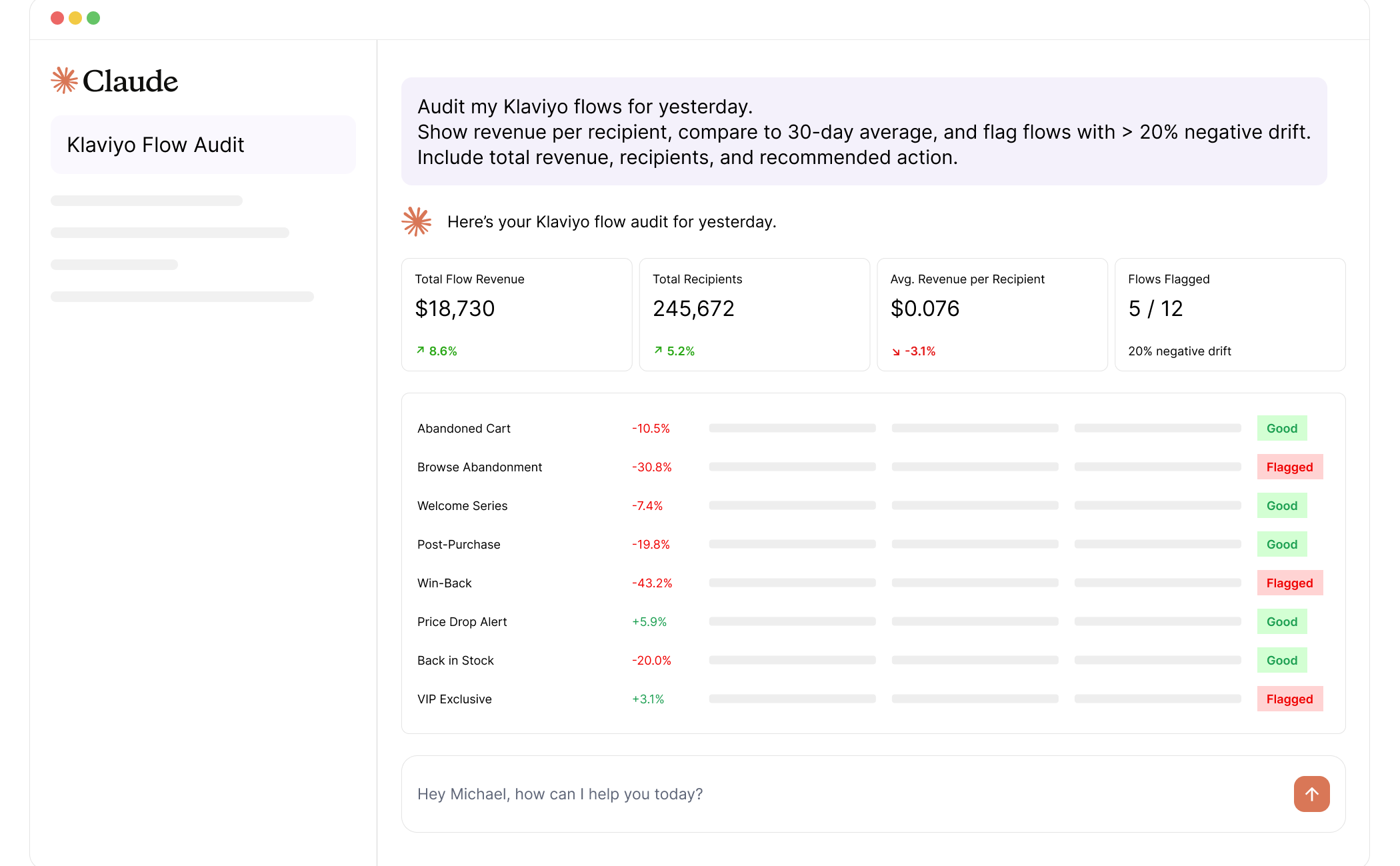
A 30-minute Klaviyo flow audit using AI + ShopMCP can identify underperforming flows, diagnose what changed, and propose brand-voice-aligned fixes — recovering revenue that was previously bleeding silently from flow drift over time. This is the operator's audit loop: 5 numbered steps, the exact prompts, the 6 flows every Shopify brand should have running, and the brand-voice guardrails that keep AI-proposed fixes consistent with your tone.
If your Klaviyo program has been running for more than 6 months, some of your flows are drifting. They were great when you set them up; the welcome flow's open rate has slipped 8%; the cart-abandonment subject lines were written before your brand voice tightened; the post-purchase flow still references a discount code that expired in February. The audit catches all of it.
Why Klaviyo flows quietly underperform
Three patterns cause Klaviyo flows to drift over time:
- Content goes stale. Brand voice evolves. Discount codes expire. Product references go out of stock. The flows you wrote 12 months ago aren't the flows your brand would write today.
- Send-time and cohort assumptions break. The customer base changes (more existing customers, fewer new subscribers; or vice versa). Send-time optimization that was right last year may not be right now.
- Deliverability shifts. Inbox placement, spam-filter changes, list hygiene degradation — all silently degrade open and click rates without an obvious cause.
The combined effect: typical Klaviyo programs lose 5-15% of flow-driven revenue per year if not actively audited. The audit recovers it.
The 30-minute audit loop
Five steps, designed to run in 30 minutes per brand:
- Step 1 (3 min) — pull the flow inventory
- Step 2 (5 min) — flag the underperformers
- Step 3 (8 min) — diagnose each flagged flow
- Step 4 (10 min) — propose fixes with brand-voice guardrails
- Step 5 (4 min) — implement the fixes that pass review
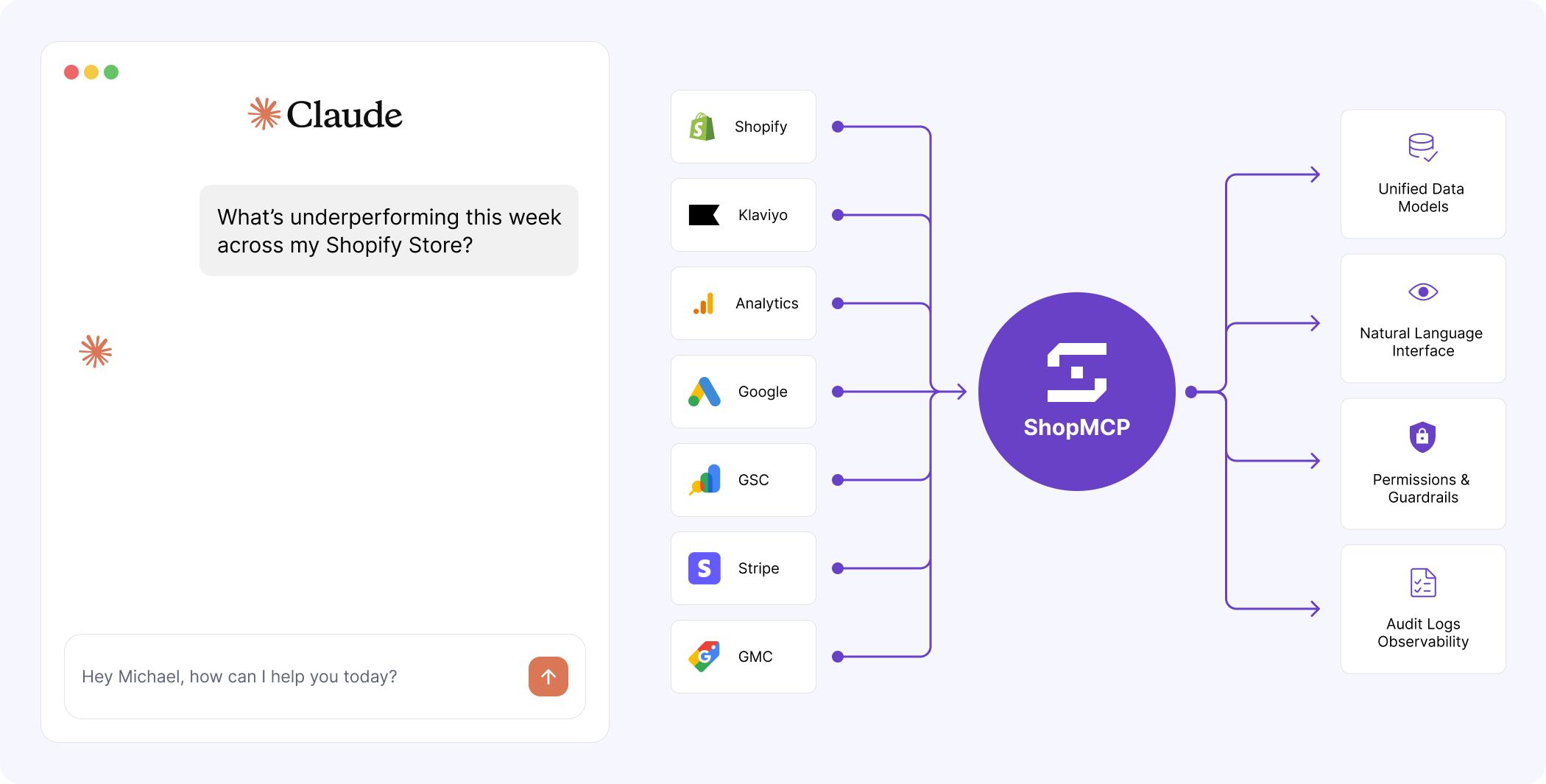
Setup: ShopMCP connected to Klaviyo. Setup tutorial: Klaviyo MCP: how to query your email data with AI.
Step 1: pull the flow inventory
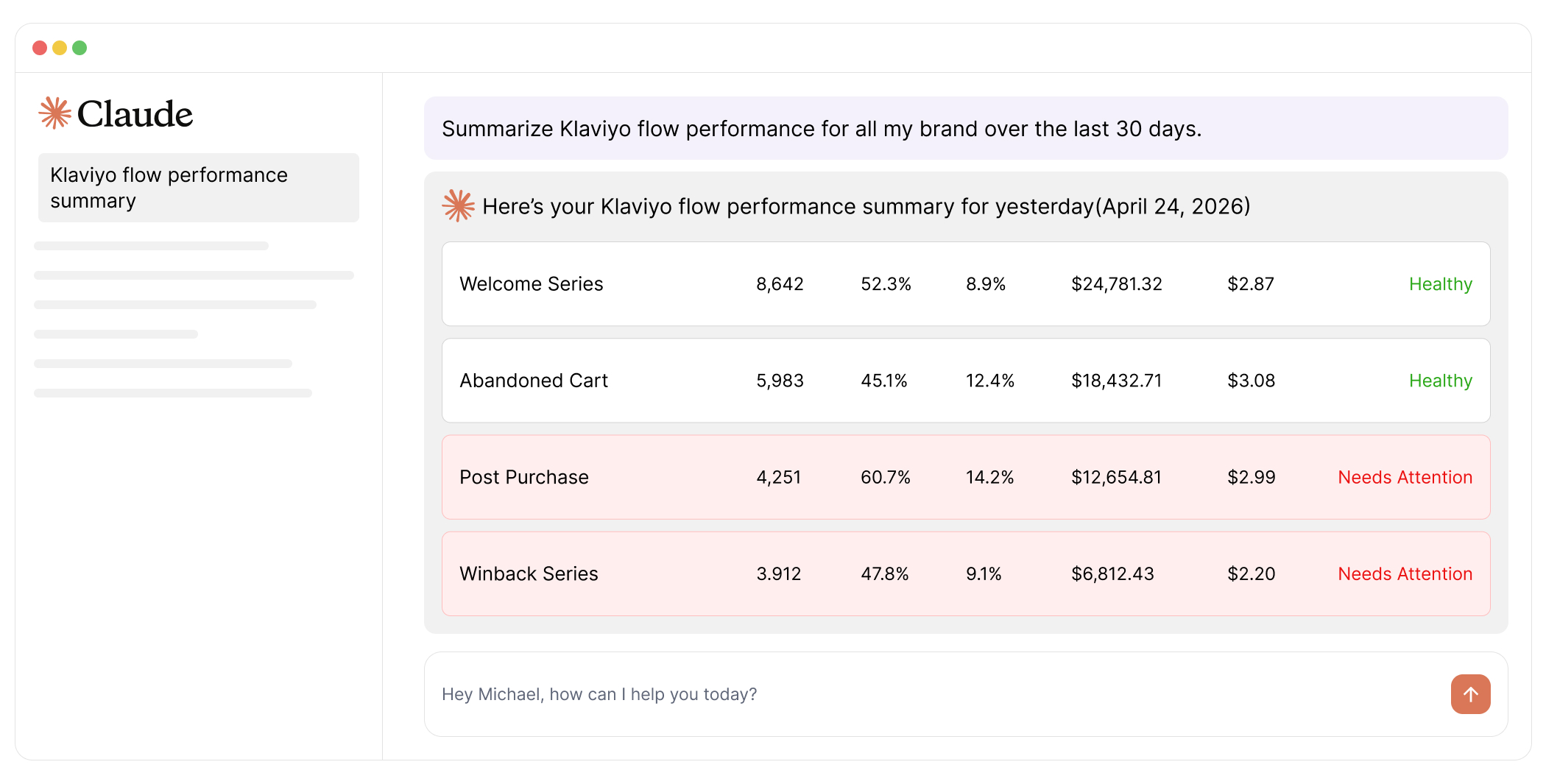
For {Brand X}, list all active Klaviyo flows. For each, show: - Flow name and trigger type - Send volume last 30 days - Open rate (last 30 days, vs the trailing 90-day baseline) - Click rate (last 30 days, vs the trailing 90-day baseline) - Revenue per recipient (last 30 days, vs trailing 90-day baseline) - Last edit date Output as a sortable table.
ShopMCP queries the flow data; output appears in 30-60 seconds.
Step 2: flag the underperformers
From the flow inventory above, flag flows meeting any of: - Revenue per recipient dropped > 15% vs the trailing 90-day baseline - Open rate dropped > 10% vs baseline - Last edit date > 60 days AND revenue per recipient is below account average Sort flagged flows by revenue impact (volume × delta-RPR) descending.
The output is your priority list. Typically 2-4 flows for a healthy program; 5-8 for a program that hasn't been audited in 6+ months.
Step 3: diagnose each flagged flow
For each flagged flow, run the diagnostic prompt:
For {Brand X}'s {Flow Name}, diagnose the performance drift: - Recent edits (subject lines, copy, send time, sender) — anything changed in the last 90 days? - Send-time changes — has the send time shifted relative to recipient timezone? - Recipient-cohort changes — has the audience profile shifted (more existing customers vs new subscribers, etc.)? - Recent unsubscribes pattern — are unsubs concentrated in one specific send within this flow? Recommend the top 3 likely root causes ranked by evidence weight.
Run this for each flagged flow. Diagnostics take ~2 minutes per flow. The AI's evidence-weighted ranking is genuinely useful — it catches root causes operators might miss in manual investigation (a send-time shift correlated with the open-rate drop, or an unsubscribe spike concentrated in a specific email within the flow).
Step 4: propose fixes with brand-voice guardrails
Before asking AI for proposed fixes, give it the brand-voice context:
{Brand X}'s brand voice is: [paste 3-5 brand-voice rules from the client's style guide]. Examples of on-brand subject lines: [paste 2-3 examples]. Examples of off-brand subject lines: [paste 2-3 examples]. Now propose 3 fixes for each of the flagged flows above. For each fix, show: current text → proposed text → why this matches the brand voice and addresses the diagnosed root cause.
The brand-voice guardrail is what turns AI-proposed fixes from generic to client-quality. Without it, AI proposes generic ecommerce email copy. With it, the proposals are usable.
Save the brand-voice context per client in your Notion prompt library. Reusable across audits.
Step 5: implement the fixes that pass review
ShopMCP can create, update, pause, activate, or delete stable-API flow resources and update or delete flow action nodes. Keep the change set narrow, match Klaviyo's API payload schema, and require explicit review before changing a live flow:
Update the approved action in {Flow X} using the validated Klaviyo API payload. Show the exact diff and require confirmation before applying.
After the write, read the flow and affected actions back from Klaviyo and compare them with the approved change. Visual-editor-only behavior or any change that cannot be represented by the stable API should still be applied manually in Klaviyo through your team's normal deployment process.
The 6 flows every Shopify brand should have
If your audit reveals you're missing one of these, building it should jump to the top of the priority list. These six are the workhorse Klaviyo flows for ecommerce:
1. Welcome series
Trigger: New email subscriber. Goal: Convert subscriber to first-time buyer. Typical structure: 3-5 emails over 7-14 days. First email confirms subscription + welcome incentive (10-15% off code or free shipping). Subsequent emails build brand story, social proof, product showcase. Audit focus: opt-in-to-purchase conversion rate; first-email open rate (typically 50%+ for healthy programs).
2. Browse abandonment
Trigger: Subscriber views product but doesn't add to cart. Goal: Recover would-be browsers. Typical structure: 1-2 emails 1-24 hours after browse event. Audit focus: lower-priority than cart abandonment but worth running; revenue per recipient is typically 30-50% of cart-abandonment levels.
3. Cart abandonment
Trigger: Subscriber adds to cart but doesn't complete checkout. Goal: Recover the cart. Typical structure: 2-3 emails over 24-72 hours. First email reminds; second offers help/discount; third creates urgency. Audit focus: the highest-leverage flow for most ecom brands; small improvements compound.
4. Checkout abandonment
Trigger: Subscriber starts checkout but doesn't complete. Goal: Recover checkouts that fell off later in the funnel than cart. Typical structure: 1-2 emails 1-24 hours after abandonment. Audit focus: higher-intent than cart abandonment (further down funnel); the per-recipient revenue is typically materially higher.
5. Post-purchase
Trigger: Customer completes a purchase. Goal: Drive repeat purchase, request reviews, increase LTV. Typical structure: 4-6 emails over 30-90 days. Order confirmation, shipping updates, delivery confirmation, review request, cross-sell, re-purchase reminder. Audit focus: review-request open rate, cross-sell conversion rate, time-to-second-purchase.
6. Win-back
Trigger: Subscriber inactive for 60-90 days. Goal: Re-engage or remove from active list. Typical structure: 2-3 emails over 14-30 days. Last email is a clear "are you still interested?" + soft removal threat. Audit focus: revenue from win-back vs cost of sending to less-engaged list; deliverability impact of keeping inactive subscribers.
When to run this audit (cadence)
- Quarterly is the baseline cadence for most brands.
- Monthly for high-volume Klaviyo programs ($1M+ annual Klaviyo-driven revenue).
- Immediately after major changes: new product launch, brand-voice refresh, deliverability change, list-source shift.
Save the audit prompts in your Notion library. Run them on cadence. The compounding revenue recovery is real but requires the rhythm.
For agency operators running the audit across multiple clients: the prompt is identical except for client name. Multi-client audit takes ~30 min × N clients, parallelizable since the AI calls are independent. Agency operators in our closed beta typically run the audit on a recurring monthly Friday.
What's next
For the Klaviyo MCP setup: Klaviyo MCP: how to query your email data with AI. For agency-shaped Klaviyo content: Klaviyo agencies: the AI tools your team should be using. For 30 specific Klaviyo prompts (broader than just flow audits): How to talk to your Klaviyo data: 30 prompts that actually work.
Frequently asked questions
What are the best Klaviyo flows for ecommerce? Six core flows generate most Klaviyo revenue for ecommerce brands: (1) Welcome series — converts new subscribers; (2) Browse abandonment — recovers shoppers who viewed products but didn't add to cart; (3) Cart abandonment — recovers carts; (4) Checkout abandonment — recovers checkouts that started but didn't complete; (5) Post-purchase — drives repeat purchase and reviews; (6) Win-back — re-engages dormant customers. Run all six. Audit them quarterly for performance drift; that's the highest-leverage Klaviyo recurring-maintenance task.
How do I audit Klaviyo flows? The 30-minute audit loop: pull the flow inventory (one prompt against ShopMCP); flag flows below account-average revenue per recipient; diagnose each flagged flow (recent edits, send volume, send-time changes, cohort changes); propose fixes with brand-voice guardrails; implement the fixes that pass review. Pre-AI this was a half-day per client; with operator-layer MCP it compresses to 30 minutes per brand.
How often should I audit Klaviyo flows? Quarterly is the baseline for most brands. Monthly for high-volume programs ($1M+ annual Klaviyo revenue) where flow drift compounds quickly. Plus an immediate audit anytime you make significant changes — new product launch, brand-voice refresh, deliverability change, or major list-source shift. The 30-minute audit cost is low enough that monthly cadence pays back even at modest brand size.
More Articles
Your coffee's still warm. Your Monday review is done.
Connect one platform in 5 minutes. Run your first playbook before the kettle boils.

2026 Copyright © ShopMCP. All rights reserved. A Perceptiv Digital initiative.