




Zendesk + ShopMCP
Track tickets, SLA risks, customer issues, and Help Center gaps before support problems slow down revenue.
Zendesk holds the customer truth that operators feel every day: angry tickets, quiet SLA risk, repeated product questions, macros that have gone stale, and Help Center articles that almost answer the question but not quite.
ShopMCP connects Zendesk Support and Guide to Claude, ChatGPT, Cursor, and other MCP-aware clients so support work can happen beside the rest of the ecommerce stack. Ask for ticket context, customer history, Help Center matches, support-rule hygiene, or a draft response without bouncing through admin tabs.
What you can ask Zendesk through ShopMCP
Start with the questions that usually take a support lead ten clicks and a spreadsheet:
- "Which unsolved Zendesk tickets need attention first today?" The queue triage pass.
- "Show SLA-risk tickets by priority, age, group, and assignee." The escalation list before customers chase twice.
- "Find every ticket, comment, and user record related to order 10001234." The ecommerce support handoff.
- "Cluster recent tickets about returns delays and show matching Help Center articles." Repeat issues and content gaps in one answer.
- "Use this ticket, its comments, and relevant KB articles to draft a careful reply." Response drafting with context attached.
- "Show stale macros, views, triggers, automations, and SLA policies that should be reviewed." Admin hygiene without wandering through settings.
- "List Help Center articles for shipping, returns, and warranty, then flag missing translations." Guide maintenance from one prompt.
Reads are available first. Writes are gated and hidden unless a workspace admin enables them.
Why Zendesk is more useful beside the rest of the store
A ticket rarely starts and ends inside Zendesk. The customer mentions an order, a product, a delivery, a promotion, a subscription, or a return policy. The answer may live in Shopify, Klaviyo, HubSpot, GA4, Stripe, Xero, or the Help Center.
Zendesk alone can show the support case. ShopMCP can put that case beside the systems that explain it.
Zendesk tickets x Shopify orders
Find tickets by order number, email, or customer id, then pull storefront context before replying. This is the difference between "please send your order number" and "I found the order and can see what happened."
Zendesk tickets x Help Center search
Cluster repeat issues, search Guide articles, and show where the content misses the customer wording. Useful for reducing repeat contacts instead of only answering them faster.
Zendesk SLA risk x customer value
Pair support urgency with customer, order, subscription, or revenue context from connected systems. High-risk tickets from high-value customers stop getting buried.
Zendesk macros x actual ticket demand
Review macros, views, triggers, automations, SLA policies, and schedules against current ticket patterns. The old support system stays cleaner when the review happens in plain English.
Built for support operators and agencies
Ecommerce support leads. Queue triage, repeat issue review, Help Center gaps, and response preparation from one place.
Founders and operators. See what customers are asking before it becomes a margin, retention, or product problem.
CX agencies. Manage multiple Zendesk accounts with labeled ShopMCP connections and a consistent support-audit playbook.
Content and ops teams. Turn ticket demand into Help Center updates instead of relying on someone to remember the pattern later.
Setup
- In Zendesk Admin Center, create an API token for a dedicated admin or agent account.
- In ShopMCP, enter the Zendesk subdomain, account email, API token, and optional account label.
- ShopMCP verifies the connection with Zendesk's current-user endpoint and stores credentials encrypted at rest.
- Keep writes off until the support workflow has been tested with a sandbox or internal account.
API-token mode is for private/admin validation. Broad customer distribution will use Zendesk Global OAuth so each customer authorizes ShopMCP through Zendesk instead of pasting long-lived credentials.
Safety, in plain English
- Reads first. Tickets, comments, audits, users, organizations, groups, fields, forms, statuses, views, macros, triggers, automations, SLA policies, schedules, Help Center content, translations, labels, user segments, permission groups, and attachment metadata.
- Writes gated. Ticket creation, ticket updates, comments, tags, user and organization updates, Help Center content, macros, views, triggers, automations, and SLA policy updates appear only when writes are enabled.
- Customer-visible actions need review. Public replies, solved-state changes, Help Center edits, and business-rule updates can affect customers immediately.
- Safe ticket updates. Ticket updates support Zendesk safe-update fields where available, so stale edits can be rejected instead of silently overwriting newer work.
- Encrypted credentials. Zendesk credentials are stored encrypted and scoped to the workspace connection.
What's under the hood
ShopMCP's Zendesk connector ships 76 tools when writes are enabled: 45 read tools, 24 write tools, and 7 composite playbooks.
The first release focuses on Zendesk Support and Guide: tickets, comments, audits, users, organizations, groups, ticket fields, forms, statuses, tags, satisfaction reasons, views, macros, triggers, automations, SLA policies, schedules, Help Center categories, sections, articles, translations, article labels, user segments, and permission groups.
The client prefers Zendesk cursor pagination where available, handles rate-limit retries, supports idempotency keys for ticket creation, and keeps write registration behind ShopMCP's workspace write gates.
Full endpoint-by-endpoint reference: the Zendesk integration spec.
Works with
Claude Desktop, Claude web, Claude Code, ChatGPT with MCP support, Cursor, and any MCP-compatible assistant.
Pricing
Zendesk MCP is included in ShopMCP workspaces where the integration is enabled. During validation, Zendesk is visible to selected workspaces only. See pricing.
Frequently asked questions
What is Zendesk MCP?
Zendesk MCP is the ShopMCP integration that lets AI assistants query and operate approved Zendesk Support and Guide tools through the Model Context Protocol.
Can Claude or ChatGPT reply to Zendesk tickets?
The connector includes comment and ticket update tools, but they stay hidden until a workspace admin enables writes. Public replies should always be reviewed before sending.
Does it search Help Center articles?
Yes. ShopMCP can list and search Zendesk Guide categories, sections, articles, labels, translations, user segments, and permission groups where the connected Zendesk account has access.
How does authentication work?
Private validation uses Zendesk API-token credentials: subdomain, email, and API token. The public customer launch path is Zendesk Global OAuth.
Does this replace Zendesk?
No. Zendesk remains the system of record for tickets, business rules, and Help Center content. ShopMCP is the AI operating layer that helps teams find context, draft responses, and join support data to the rest of the store stack.
Is Zendesk MCP read-only at launch?
It launches admin-only with writes off by default. Write tools exist for controlled testing, but they are not registered unless the workspace write toggle is enabled and the global launch gate permits writes.
Related reading
- Pair with: Shopify MCP - order and customer context.
- Pair with: Klaviyo MCP - retention context behind support complaints.
- Pair with: HubSpot MCP - CRM and account context.
- Setup guide: Connect Zendesk to ShopMCP.
Connect Zendesk to Claude or ChatGPT
Bring support tickets, Help Center content, customer context, and support-rule hygiene into the same AI workspace as the rest of your ecommerce stack. Start your connection.
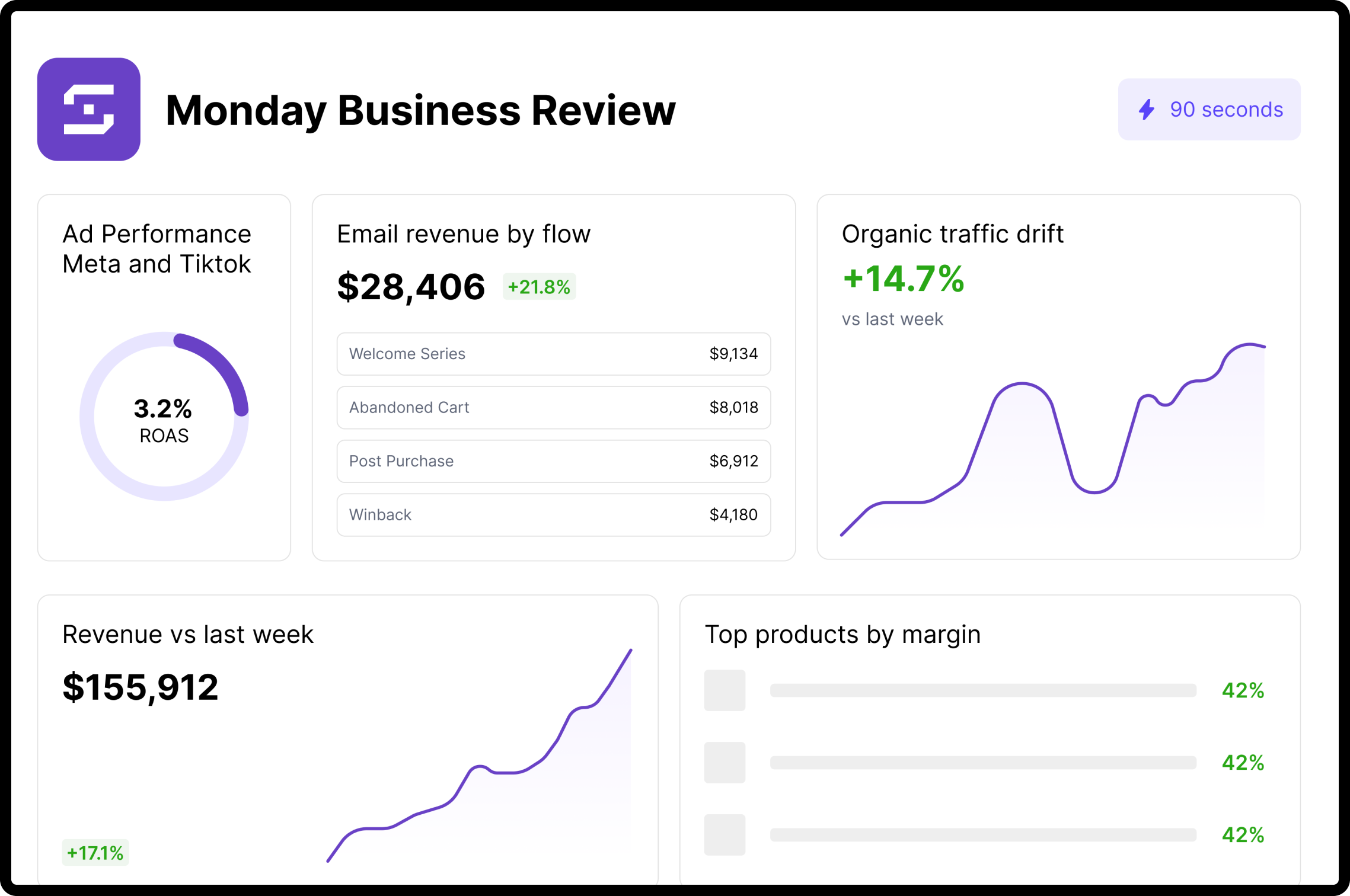
Your coffee's still warm. Your Monday review is done.
Connect one platform in 5 minutes. Run your first playbook before the kettle boils.

2026 Copyright © ShopMCP. All rights reserved. A Perceptiv Digital initiative.