
Shopify
Shopify Analytics Tools Compared: 12 Options for 2026
Date
June 01, 2026
Author
Igor Cerjan
There is no single "best" Shopify analytics tool — the right pick depends on whether your team needs attribution, dashboarding, a data warehouse, cohort analysis, or an AI-native operator layer. This is the honest 2026 comparison: 12 tools mapped to the job each one is genuinely good at, with pricing transparency and no fake winners.
We won't pretend ShopMCP wins every category. We'll tell you when Triple Whale fits, when Polar fits, when Daasity is worth the money, and when none of these is what you actually need. By the end you'll know which one to evaluate first — or whether you should keep shopping.
TL;DR — pick by what your team needs
A 60-second decision tree:
- You're a paid-acquisition-heavy DTC brand obsessed with attribution. → Triple Whale or Northbeam.
- You're an ops team that wants flexible dashboards and lives in spreadsheets. → Polar Analytics.
- You're past $20M ARR and ready to model data yourself. → Daasity, Glew, or BigQuery + Looker.
- You want LTV / cohort views above all else. → Peel Insights.
- You're an agency or ops team who wants plain-English access across Shopify, Klaviyo, GA4, ads, and GSC in one place. → ShopMCP.
- You only need basic numbers and want to spend zero. → Shopify Reports + GA4. Don't overpay.
The rest of this post is the long form: criteria, the 12 tools, side-by-side, and use-case recommendations.
How we evaluated
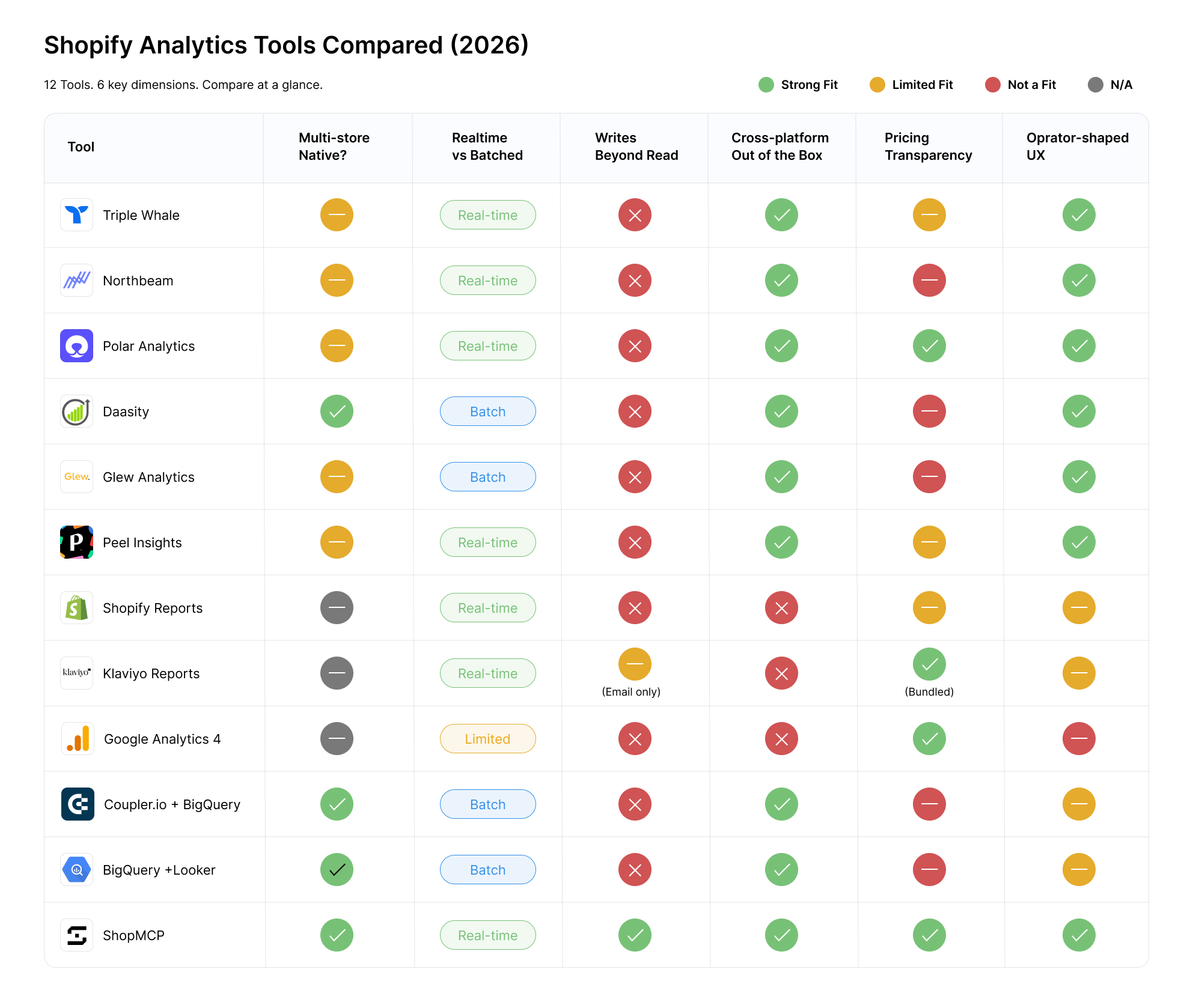
Six dimensions matter for ecommerce operators. Every tool gets graded against the same checklist:
- Multi-store native? Critical for agencies. Many "Shopify analytics" tools assume one store.
- Real-time vs batched? Triple Whale-style real-time vs warehouse-style daily refresh — different operating models.
- Writes (not just reads)? Can the tool do anything beyond display, or is it a read-only window?
- Cross-platform out of the box? Does it connect to Klaviyo, Google Ads, GA4, GSC without an integration project?
- Pricing transparency. Public pricing on the vendor site = good signal. Quote-only with sales calls = friction.
- Operator-shaped UX. Does the tool surface answers, or just dashboards you have to interpret?
ShopMCP is included in the comparison because we built it. We've tried to be evenhanded — every other tool below has a real positive use case, and we'll tell you when our tool is the wrong choice.
The 12 tools by category
Dashboards
Triple Whale
Triple Whale describes itself as the "AI data platform for ecommerce" with a focus on attribution and "Sonar" pixel-based tracking. It's the dominant attribution-first dashboard for DTC brands — 6,100 monthly US searches for the brand name confirms its market position.
Built for: mid-market DTC brands with significant paid spend who care about multi-touch attribution and want a polished real-time dashboard.
Strengths (per their own marketing): Sonar pixel claims to track post-iOS-14 attribution accurately. Real-time dashboards. Strong creative reporting (which ads are working). Slack integration for proactive alerts.
Tradeoffs: Pricing scales with revenue and historically lands in the higher hundreds to thousands per month for serious users. Single-store-leaning UX makes multi-tenant agency workflows possible but not effortless. Attribution accuracy claims are debated in the community — verify with your own data.
When it fits: you're DTC, you spend > $50K/month on ads, and attribution is a top-three priority.
Polar Analytics
Polar Analytics positions as "the all-in-one analytics platform for DTC brands" with strong sheets-style flexibility — pivot tables, custom metrics, and a UX that ops people who came up in spreadsheets find familiar.
Built for: DTC ops teams who want flexibility without committing to a warehouse.
Strengths: Sheets-friendly UX. 700 vol/month brand search confirms a real audience. KD 4 means fast SERP — they're growing. Lightweight setup compared to a true warehouse.
Tradeoffs: Less attribution-centric than Triple Whale. Cross-platform connectors (Klaviyo, ads) are good but each needs its own setup time.
When it fits: ops-led teams who want flexibility but aren't ready for warehouse complexity.
Shopify Reports (native)
Shopify's built-in reporting. Free, included, often overlooked.
Built for: every Shopify merchant.
Strengths: Already there. Already populated. The reports surface basics (sales by channel, top products, customer cohorts, marketing) without any setup. For brands under $5M ARR, this is genuinely enough analytics for most days.
Tradeoffs: Single-store. No cross-platform. Customization is limited. No real attribution beyond Shopify's own first-touch.
When it fits: small brands who don't need anything more, or as the always-available baseline alongside something heavier.
Attribution-first
Northbeam
Northbeam markets as MTA (multi-touch attribution) for sophisticated ecom brands, with claims of post-cookie tracking accuracy and a strong creative-analytics focus.
Built for: mid-market+ DTC brands ($10M+ ARR) where attribution accuracy is a strategic priority and the team has the patience to model attribution windows seriously.
Strengths: 1,900 vol/month brand search. CPC of $11 is among the highest in the category — pure commercial intent. Creative-level performance reporting. MTA modeling that's honest about its assumptions.
Tradeoffs: Higher cost. Real implementation time. Operating model requires ongoing model-tuning attention; not a "set up and forget" tool.
When it fits: $10M+ DTC brands with a dedicated growth/analytics person who can own attribution modeling.
Data warehouse
Daasity
Daasity ships a Shopify-shaped data warehouse — pre-modeled tables for orders, products, customers, fulfillments — with BI on top (typically connected to Looker, Tableau, or their own visualization layer).
Built for: data-mature brands ready to own their analytics stack.
Strengths: 450 vol/month brand search confirms real adoption. Pre-modeled data saves months of warehouse-from-scratch work. Standardized schema makes cross-brand benchmarking possible (relevant for portfolio companies and agencies running enterprise clients).
Tradeoffs: You need a SQL person, or willingness to learn. Higher monthly cost. Warehouse maintenance is real work — don't buy this if you're not going to use it.
When it fits: $20M+ ARR brands with a data analyst on staff, or agencies running enterprise clients who need consistent reporting across portfolios.
Glew Analytics
Glew positions as full ecommerce BI — dashboards plus warehouse-style flexibility, with subscription analytics, customer lifetime value, and merchandising as headline use cases.
Built for: mid-to-large brands who want BI without building it themselves.
Strengths: $17 CPC is the highest in the category — that's serious commercial intent. Subscription-aware metrics (rare). Pre-built dashboards reduce time-to-insight.
Tradeoffs: Brand search is small (50 vol/month) — niche awareness, not mass-market. Pricing has historically required a sales conversation, which adds friction for self-serve buyers.
When it fits: subscription brands or BI-mature mid-market teams who'd otherwise build dashboards from scratch.
BigQuery + Looker / Looker Studio + Coupler.io
The DIY warehouse path. Coupler.io (or Fivetran/Airbyte) pipes Shopify, Klaviyo, ads, and GA4 into BigQuery. Looker or Looker Studio provides visualization.
Built for: technical teams who want maximum control.
Strengths: Cheapest at scale once you've built it. Maximum flexibility. You own your data warehouse and can do anything.
Tradeoffs: Months of setup. Ongoing maintenance. Schema design and modeling are entirely on you. Pre-built warehouse vendors (Daasity, Glew) exist precisely because most teams find this path harder than they expected.
When it fits: brands with a real data team and a real reason not to use a packaged warehouse.
Cohort + behavioral
Peel Insights
Peel focuses on cohort analytics, LTV modeling, and customer-behavior reporting — the questions that aggregate dashboards make hard to answer.
Built for: brands where retention and LTV are the strategic levers.
Strengths: Well-built cohort views. $9 CPC, KD 5 — real commercial demand at low difficulty. Often praised for the depth of cohort visualization in their own marketing.
Tradeoffs: Single-purpose. You'll still need a different tool for daily revenue dashboards or paid-attribution.
When it fits: subscription brands, retention-led brands, or teams adding cohort analysis as a complement to a dashboard tool.
AI-native / MCP
ShopMCP
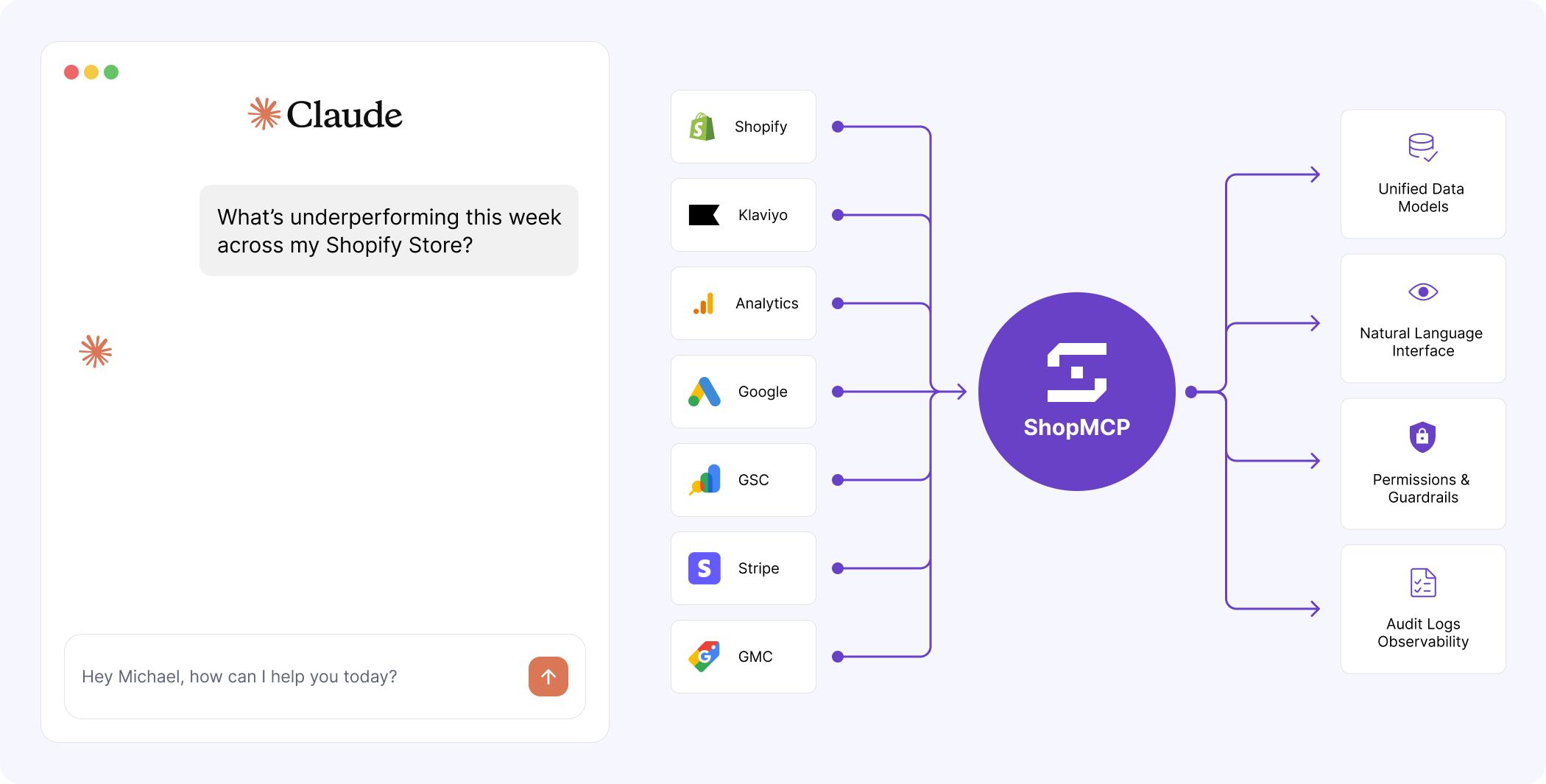
ShopMCP is the operator-and-agency layer for ecommerce MCP. Instead of a dashboard, you ask Claude, ChatGPT, or Cursor a question and get the answer. Same data scope as a dashboard tool, plus Klaviyo, GA4, Google Ads, GSC, Stripe, and Google Merchant Center bundled into one MCP connection.
Built for: agency operators (5-30 client stores), in-house ecom ops at $5-50M ARR DTC brands, technical solo founders.
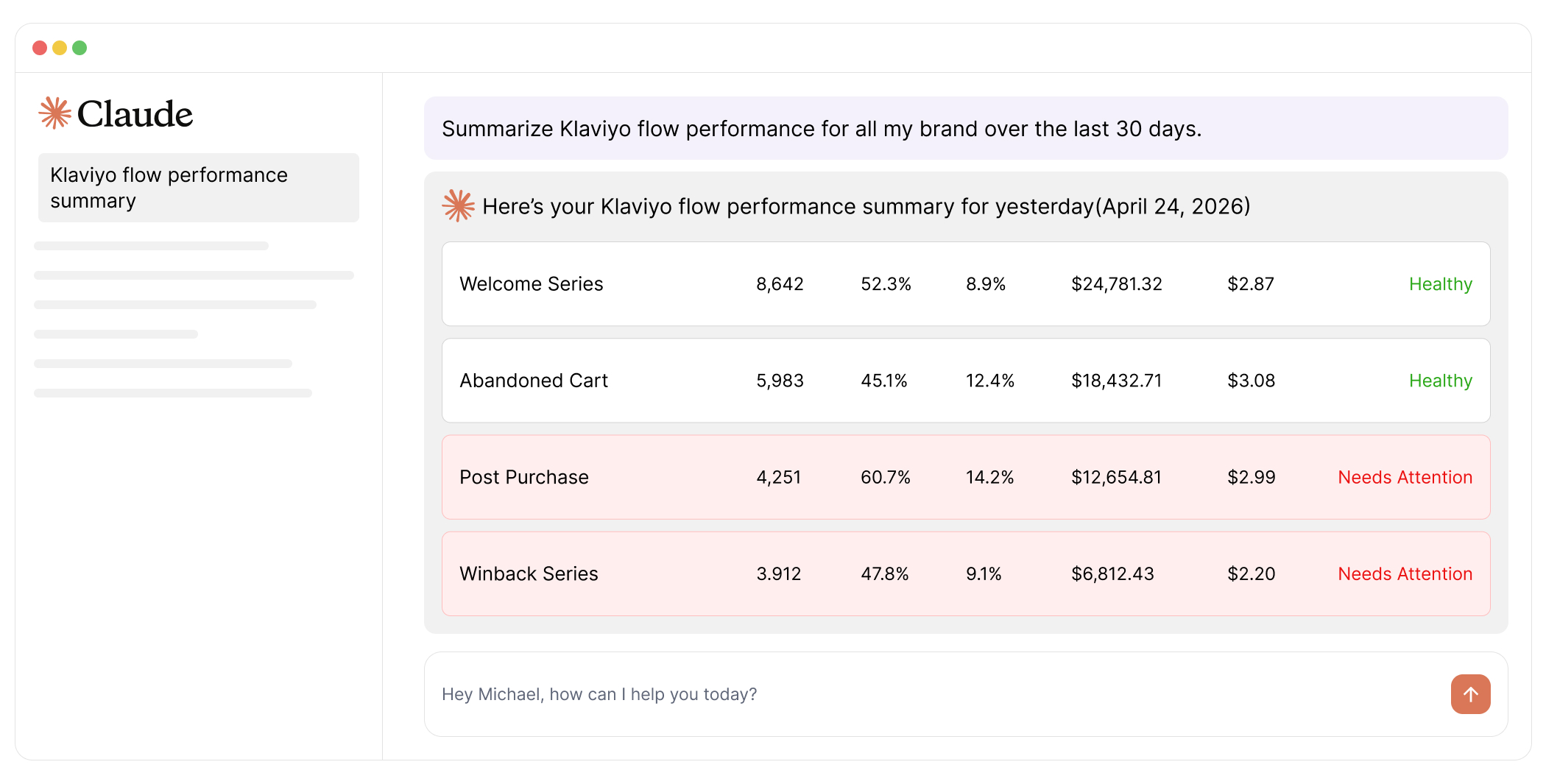
Strengths: Multi-tenant native. Cross-platform out of the box. Prompts replace dashboards — "correlate yesterday's revenue drop with Klaviyo flow performance and ad-spend changes" in one conversation. Writes (with confirmation) for inventory adjustments, draft orders, discount codes.
Tradeoffs: New category. If your team isn't already using Claude, ChatGPT, or Cursor, the AI-native pattern won't land. Not yet a fit for shopper-facing chat (use Shopify Storefront MCP for that).
When it fits: the operator-and-agency persona this whole comparison is written for. If your daily routine is built around clicking five tabs to assemble one number, MCP collapses it.
In-stack reporting
Klaviyo Reports
If you already pay for Klaviyo, the bundled reporting answers email/SMS-shaped questions natively.
Built for: any Klaviyo customer.
Strengths: Free with Klaviyo. Already populated. The right tool for "what's my best-performing flow" without a new vendor.
Tradeoffs: Doesn't see anything outside Klaviyo. Not a Shopify analytics replacement — a complement.
Google Analytics 4
GA4 ships with every ecommerce setup that bothers to install it. Free.
Built for: every ecommerce site needing baseline traffic and conversion analytics.
Strengths: Free. Universal. Pairs with Search Console for organic insight. Powerful event model for technical teams.
Tradeoffs: Notorious UX. Real-time inadequate. Not designed for ecommerce ops specifically.
When it fits: the always-on baseline behind any other tool. Don't be the brand that doesn't have GA4 wired up.
Side-by-side matrix
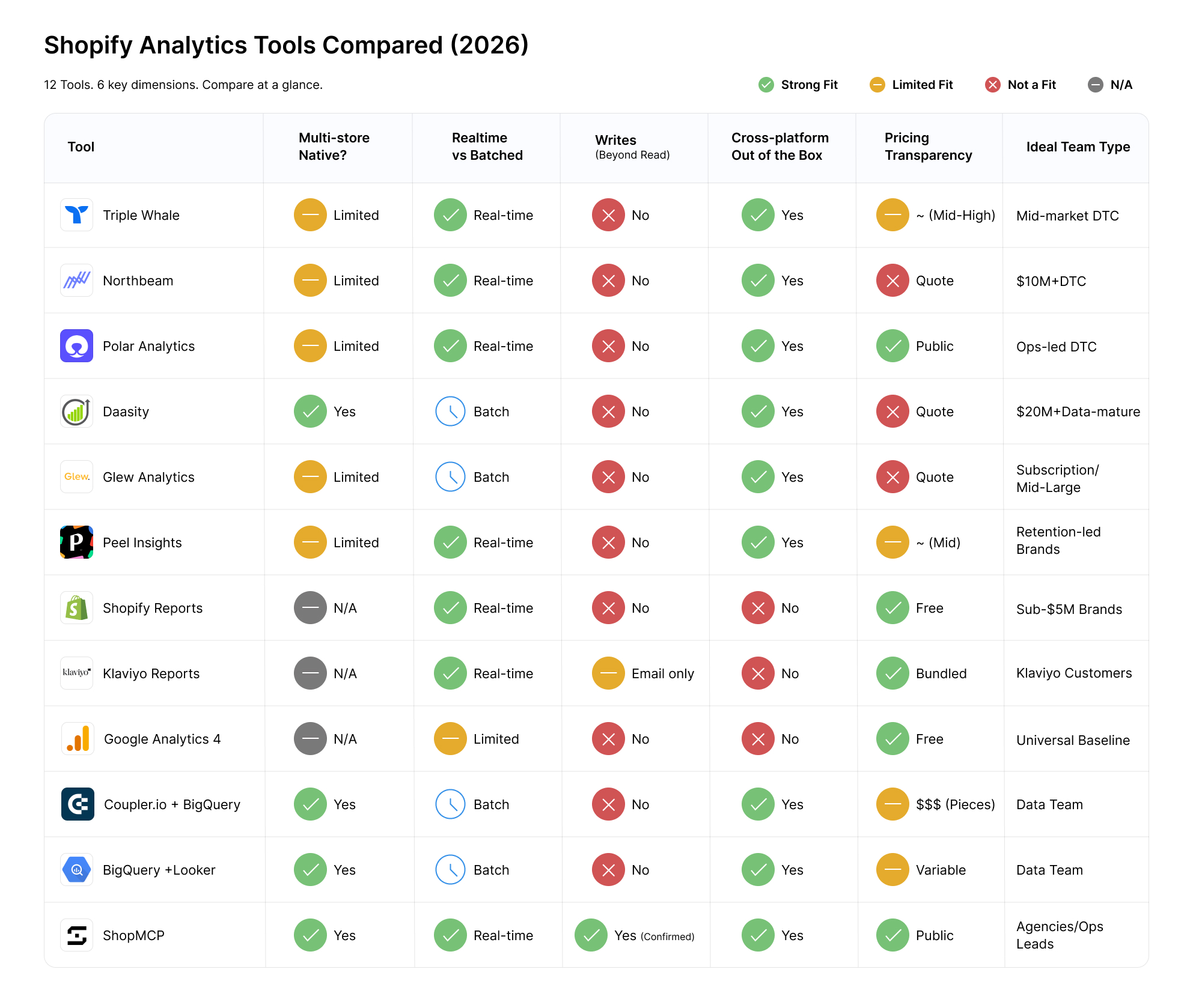
| Tool | Multi-store | Real-time | Writes | Cross-platform | Public pricing | Ideal team |
| Triple Whale | Limited | ✓ | — | ✓ (paid+) | ~ | Mid-market DTC |
| Northbeam | Limited | ✓ | — | ✓ | Quote | $10M+ DTC |
| Polar Analytics | Limited | ✓ | — | ✓ | ✓ | Ops-led DTC |
| Daasity | ✓ | Batch | — | ✓ | Quote | $20M+ data-mature |
| Glew | Limited | Batch | — | ✓ | Quote | Subscription / mid-large |
| Peel Insights | Limited | ✓ | — | ✓ | ~ | Retention-led |
| Shopify Reports | — | ✓ | — | — | Free | Sub-$5M brands |
| Klaviyo Reports | — | ✓ | Email-only | — | Bundled | Klaviyo customers |
| GA4 | — | Limited | — | — | Free | Universal baseline |
| Coupler + BigQuery | ✓ | Batch | — | ✓ | $$$ pieces | Data team |
| BigQuery + Looker | ✓ | Batch | — | ✓ | Variable | Data team |
| ShopMCP | ✓ first-class | ✓ | ✓ confirmed | ✓ | ✓ | Agencies / ops leads |
(Verify all current pricing on each vendor's website before committing — analytics tool pricing changes 1-2 times per year on average, and the differences between sticker price and the price you'll actually pay after volume tiers, second-year increases, and overage charges are real. This snapshot reflects mid-2026 vendor pricing pages.)
Which to pick by team type
- Solo founder, $0-500K ARR. Shopify Reports + GA4. Don't pay for analytics yet.
- Growing DTC brand, $500K-$5M ARR. Shopify Reports + GA4 + Klaviyo Reports. Maybe Polar Analytics if you want better dashboards.
- Mid-market DTC, $5-20M ARR, paid-heavy. Triple Whale or Polar, plus ShopMCP for ops-shaped questions.
- Mid-market DTC, $5-20M ARR, ops-heavy. ShopMCP + Polar Analytics. The combination covers daily ops + flexible deeper dives.
- $20M+ ARR with a data team. Daasity or Glew + ShopMCP for the operator-friendly daily layer.
- Subscription / retention-led brand, any size. Peel Insights + your dashboard tool.
- Agency, 5-30 clients. ShopMCP is the only first-class multi-tenant tool in this list. Pair with each client's existing tools as needed.
What's next
If you're agency-leaning, Triple Whale alternatives and Polar Analytics alternatives go deeper on those head-to-heads. For warehouse-curious buyers, Daasity alternatives and Glew alternatives are the dedicated comparisons. To see what an AI-native dashboard actually feels like on a Tuesday, the 10-minute morning ecommerce dashboard shows the daily ritual.
Try ShopMCP free for 14 days → · Read the keystone
Frequently asked questions
What is the best Shopify analytics tool in 2026? There is no single best Shopify analytics tool — the right pick depends on team type. Triple Whale is the dominant attribution-first dashboard. Polar Analytics suits ops teams who want sheets-friendly customization. Daasity and Glew suit teams ready for a data warehouse. ShopMCP is the AI-native operator layer for agencies and ops teams who want plain-English access across Shopify, Klaviyo, GA4, and ads.
How much do Shopify analytics tools cost? Free options exist (Shopify's native Reports, GA4, Klaviyo's bundled reports). Mid-range dashboards (Triple Whale, Polar Analytics) typically start in the low hundreds of dollars per month. Data warehouse tools (Daasity, Glew, BigQuery setups) start higher and scale with data volume. Always check current vendor pricing pages — analytics tool pricing changes frequently.
Do I need Triple Whale or Northbeam for attribution? If multi-touch attribution is a top-three job for your team and you have the spend to justify it, yes. If your job is operator-shaped — running daily ops, multi-store reporting, agency client work — attribution is one slice of the data, not the whole picture, and a cross-platform AI layer like ShopMCP often delivers more day-to-day value at lower cost.
What's the difference between a Shopify dashboard and a Shopify data warehouse? A dashboard (Triple Whale, Polar) presents pre-built views of your data with limited customization. A data warehouse (Daasity, Glew, BigQuery) ingests raw data so you can model and query however you want — but it requires SQL skills and ongoing maintenance. Most teams under $20M ARR don't need a warehouse; many that buy one don't use it.
More Articles
Your coffee's still warm. Your Monday review is done.
Connect one platform in 5 minutes. Run your first playbook before the kettle boils.

2026 Copyright © ShopMCP. All rights reserved. A Perceptiv Digital initiative.