
Comparisons
Triple Whale Alternatives: 8 Options for 2026 (Compared Honestly)
Date
June 16, 2026
Author
Igor Cerjan
Triple Whale is the dominant attribution-first dashboard for DTC brands and the right answer for many teams — but it's not universal. This is the honest 2026 list of alternatives, mapped to the job each one is genuinely good at, with no fake winners.
Triple Whale describes itself as the "AI data platform for ecommerce," with Sonar pixel-based attribution and real-time creative reporting as headline strengths. If you're a paid-acquisition-heavy DTC brand who cares about post-iOS-14 attribution and the price fits, it's a defensible pick. The alternatives below exist for the teams whose job isn't quite that shape.
We won't pretend ShopMCP is a universal Triple Whale replacement. ShopMCP is in this list because it's the right answer for one specific job (agencies and operators running multi-store, multi-platform workflows). It is not the right answer for the attribution-first DTC brand job, which is Triple Whale's strength.
First, when is Triple Whale the right answer?
Per Triple Whale's own marketing: real-time dashboards, Sonar pixel attribution, strong creative reporting (which ads are working), Slack-integrated alerts. They've earned 6,100 monthly US searches for their brand name — that's real adoption.
If the bullets below describe your team, Triple Whale stays on the shortlist:
- DTC brand spending > $50K/month on paid acquisition.
- Multi-touch attribution is a top-three priority.
- You want a polished real-time dashboard that ops people open every morning.
- Your unit economics support the pricing tier (verify current pricing on triplewhale.com).
- You're primarily focused on one brand (or a small portfolio you control), not 10+ client stores.
If those bullets fit, you might still be on the wrong tool — but Triple Whale earned the consideration. Read the rest of this list with that lens.
When you might want an alternative
Three situations send teams shopping for alternatives:
- Cost. Triple Whale's pricing scales with revenue and lands higher than several alternatives. For mid-market brands not running attribution at scale, the price-to-value math doesn't always work.
- Fit. Triple Whale is attribution-first. If your job is operator-shaped (daily ops, multi-store reporting, agency client work) more than attribution-shaped, the tool's strengths don't match your daily routine.
- Multi-tenant. Triple Whale supports multi-store usage. Agencies in our closed beta running 5-30 clients have reported workflow friction with single-tenant-leaning tools that purpose-built operator-layer tools don't impose; we don't claim this is universal — verify with your own team's workflow before switching.
If any of those three describe your situation, the eight alternatives below are worth evaluating.
The 8 alternatives, by job
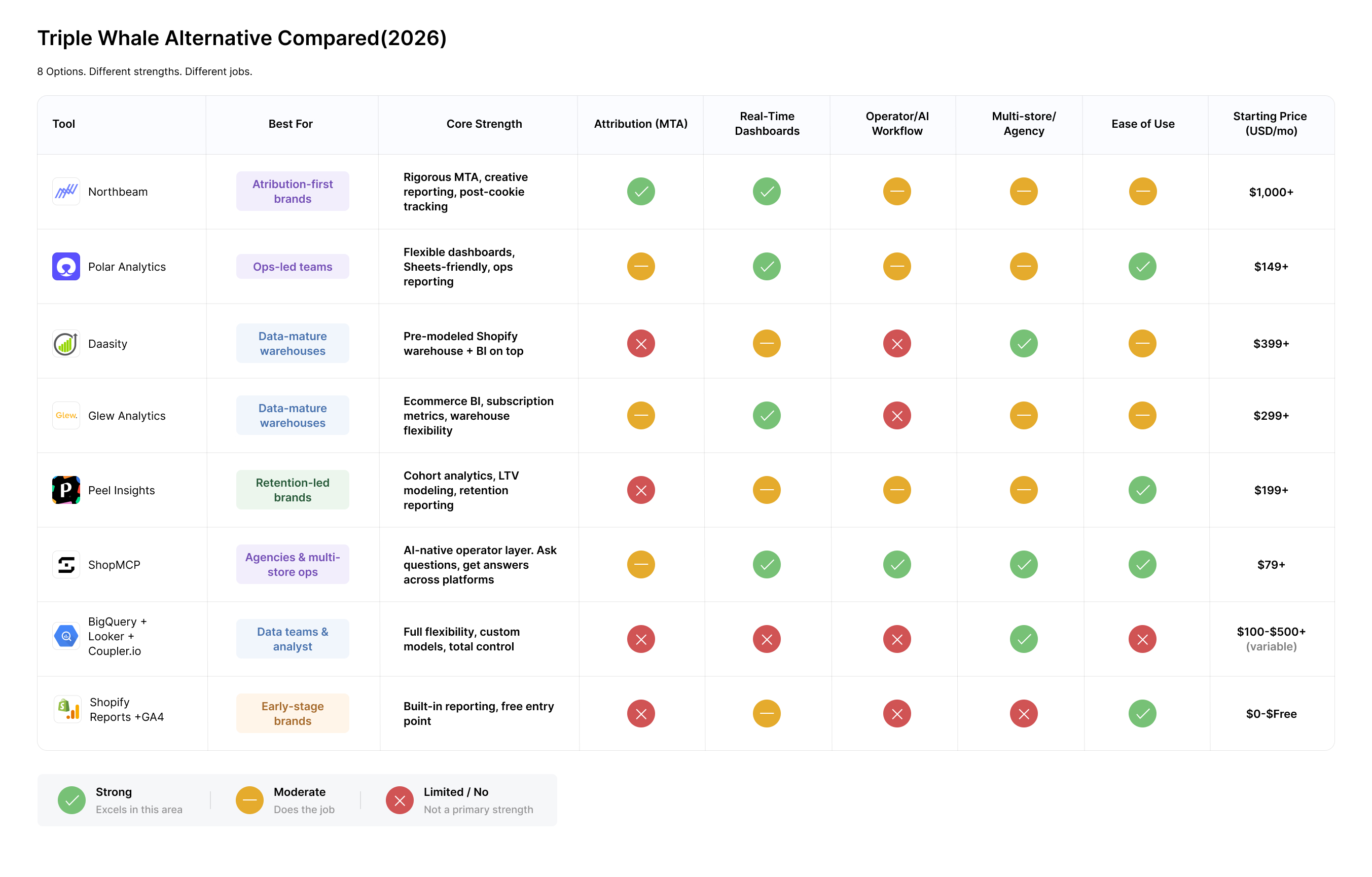
For attribution-first brands → Northbeam · Polar Analytics
Northbeam positions as MTA (multi-touch attribution) for sophisticated ecom. Per their marketing: rigorous attribution modeling, creative-level performance reporting, post-cookie tracking. KD 10 / 1,900 brand searches per month / $11 CPC = strong commercial signal. Implementation is real work; payoff for $10M+ brands with dedicated growth analysts can be material.
Polar Analytics is the lighter-weight option in this category. Sheets-friendly UX, ops-leaning, stronger flexibility than Triple Whale for teams who came up customizing Excel. KD 4, 700 brand searches — growing.
When to pick which: Northbeam if attribution rigor is the strategic priority. Polar if you want flexibility without the complexity tax.
For ops-led teams → Polar Analytics · ShopMCP
If your daily routine is more "what's going on across my brand right now" than "how should I weight last-touch vs view-through," the ops-shaped tools win.
Polar Analytics as above — flexible dashboards for ops teams.
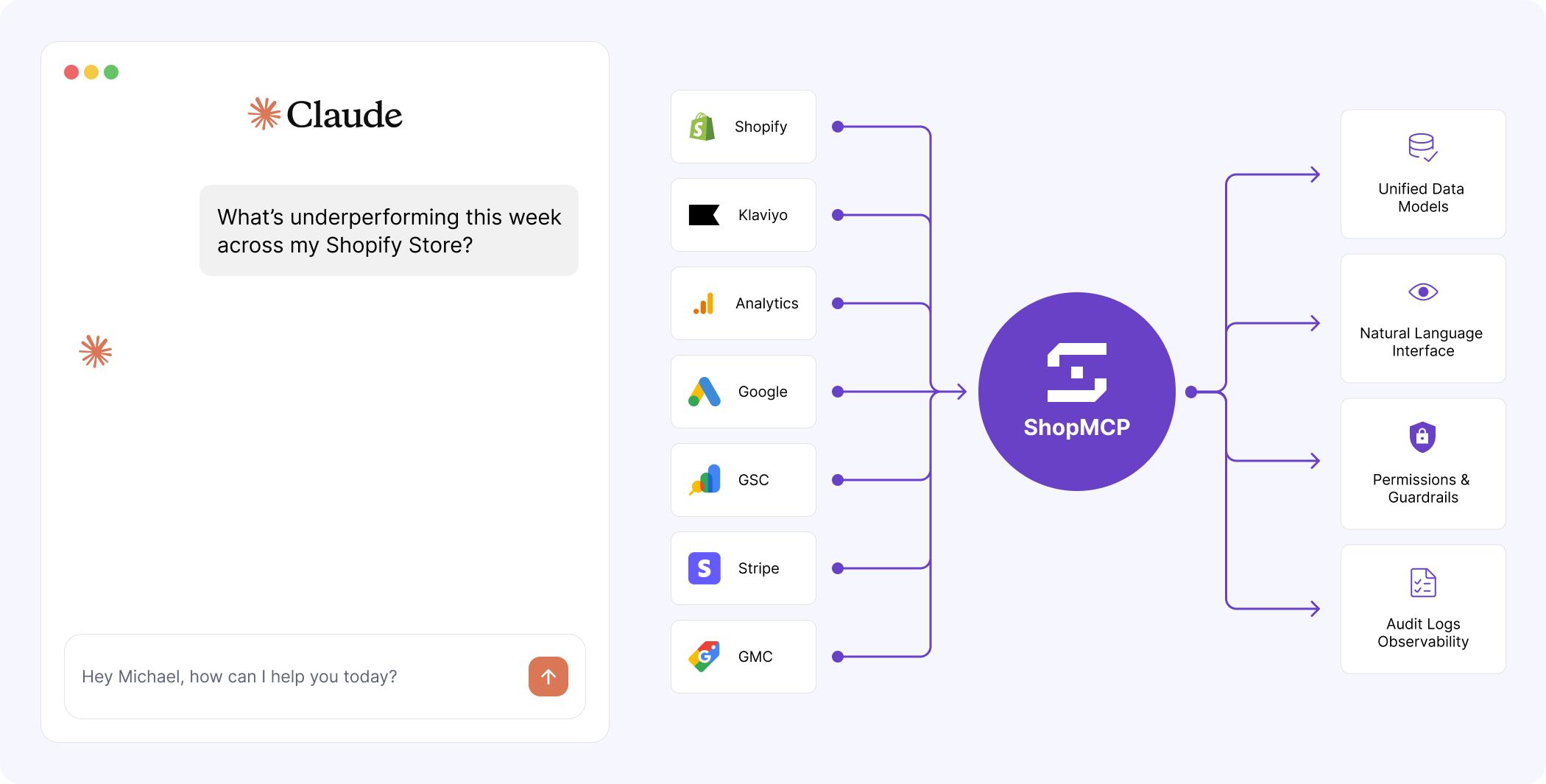
ShopMCP is the AI-native operator layer — instead of a dashboard, you ask Claude or ChatGPT a question and get an answer. Same data scope as a dashboard, plus Klaviyo, GA4, Google Ads, GSC, Stripe, and Google Merchant Center bundled in one MCP connection. For teams already using Claude Code or ChatGPT in their daily workflow, this beats dashboard-juggling.
When to pick which: Polar if you want a polished UI your team can adopt without behavior change. ShopMCP if your team already lives in AI clients and wants the data layer to match.
For data-mature warehouses → Daasity · Glew
If you're past $20M ARR with a real data analyst on staff, the warehouse path may pay off.
Daasity ships pre-modeled Shopify-shaped warehouse tables with BI on top. Saves months of warehouse-from-scratch work. Best for portfolio companies and agencies running enterprise clients who need consistent reporting across brands.
Glew is full ecommerce BI — dashboards plus warehouse-style flexibility. Subscription-aware metrics make it stronger for subscription brands.
When to pick which: Daasity if you want a packaged Shopify warehouse you can extend. Glew if you want BI dashboards built around ecommerce-specific metrics with less DIY.
For retention-led brands → Peel Insights
Peel focuses on cohort analytics, LTV modeling, and customer-behavior reporting. The questions aggregate dashboards make hard to answer (cohort revenue, retention curves, predicted CLV) are Peel's strength. KD 5 / $9 CPC = real demand at low difficulty.
When to pick: subscription brands or retention-led DTC brands who'd otherwise complement Triple Whale (or replace it) with a cohort tool.
For agencies running multiple clients → ShopMCP
If you run an ecommerce agency with 5-30 client stores and your daily routine includes assembling reports across all of them — this is the job ShopMCP is purpose-built for.
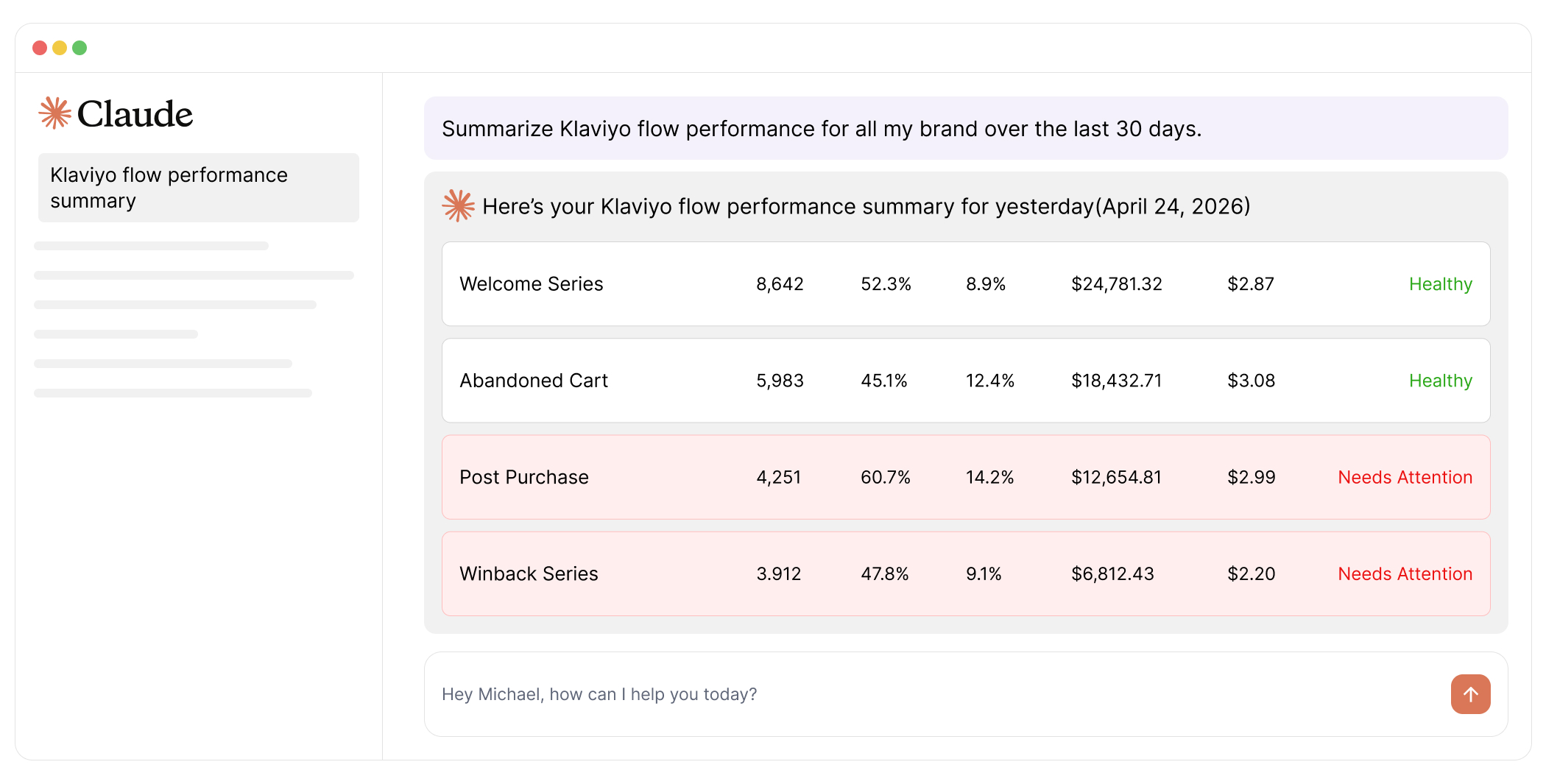
Multi-tenant native. Workspace-per-client. Cross-platform queries. "For each client workspace, summarize yesterday: revenue, AOV, top sellers, Klaviyo performance, ad spend" runs in parallel and returns one result. The full deep-dive is in AI for ecommerce agencies: the operator stack for 2026.
Triple Whale and ShopMCP can also coexist for agencies whose clients want both — Triple Whale for the attribution conversation, ShopMCP for the daily ops layer. Different jobs.
For DIY data teams → BigQuery + Looker + Coupler.io
The DIY warehouse path. Coupler.io (or Fivetran/Airbyte) pipes Shopify, Klaviyo, ads, and GA4 into BigQuery. Looker Studio provides visualization. Cheapest at scale once you've built it; maximum flexibility; you own everything.
The catch: months of setup, ongoing maintenance, schema modeling on you. Most teams who think they want this path end up at Daasity or Glew — packaged warehouse vendors exist precisely because the DIY path is harder than it looks.
When to pick: brands with a real data team and a real reason not to use a packaged warehouse.
For scrappy DTC brands → Shopify Reports + GA4 (+ a paid layer)
Don't overpay. Brands under $5M ARR running modest paid spend often don't need any of the above. Shopify's native Reports + GA4 + Klaviyo's bundled reports cover most decisions.
Add a paid layer (Polar Analytics, ShopMCP, or a creative attribution tool) when a specific question keeps recurring and the free tools can't answer it. Not before.
Side-by-side at-a-glance
| Multi-store | Real-time | Attribution depth | Cross-platform native | Pricing tier | Ideal team | |
| Triple Whale | Limited | ✓ | Strong (Sonar) | ✓ paid+ | $$$$ | Mid-market+ DTC, paid-heavy |
| Northbeam | Limited | ✓ | Strongest (MTA) | ✓ | $$$$ | $10M+ DTC, dedicated growth analyst |
| Polar Analytics | Limited | ✓ | Moderate | ✓ | $$-$$$ | Ops-led DTC |
| Daasity | ✓ | Batch | Via warehouse | ✓ | $$$$ | $20M+, data team |
| Glew | Limited | Batch | Moderate | ✓ | $$$-$$$$ | Subscription / mid-large |
| Peel Insights | Limited | ✓ | Cohort-focused | ✓ | $$-$$$ | Retention-led |
| ShopMCP | ✓ first-class | ✓ | Pass-through | ✓ deep | $-$$ | Agencies / ops |
| BigQuery+Looker | ✓ | Batch | DIY | ✓ | Variable | Data team |
| Shopify+GA4 | — | ✓ | Limited | — | Free | Sub-$5M |
(Verify current vendor pricing on each vendor's website — analytics tool pricing changes frequently.)
Honest pricing context
Pricing claims age fast in this category. As a rough framing as of 2026:
- Triple Whale, Northbeam, Daasity, Glew typically start in the higher hundreds and scale into thousands per month for serious users. Quote-based pricing common for the mid-market+ tiers.
- Polar Analytics, Peel Insights, ShopMCP tend to start lower with public-tier pricing for self-serve adoption.
- DIY warehouse paths look cheaper on the vendor invoice but real cost includes engineering time, storage, and ongoing maintenance.
The right pricing comparison isn't sticker price — it's price per insight your team will actually use. A $1,000/month tool that drives weekly decisions is cheaper than a $300/month tool that nobody opens.
How to switch (migration considerations)
If you've decided to switch off Triple Whale or layer an alternative alongside, three operational notes:
- Don't kill data continuity. Most teams underestimate how much historical context lives in the dashboard they're leaving. Export key reports and metric trends before switching.
- Run them in parallel for 30 days. The biggest mistake is full cut-over before the new tool is producing trustworthy answers. Parallel use surfaces gaps cheaply.
- Cancel deliberately. Triple Whale (and most vendors) charge by billing cycle. Schedule the cancel for after parallel-validation completes, not when you sign the new contract.
What's next
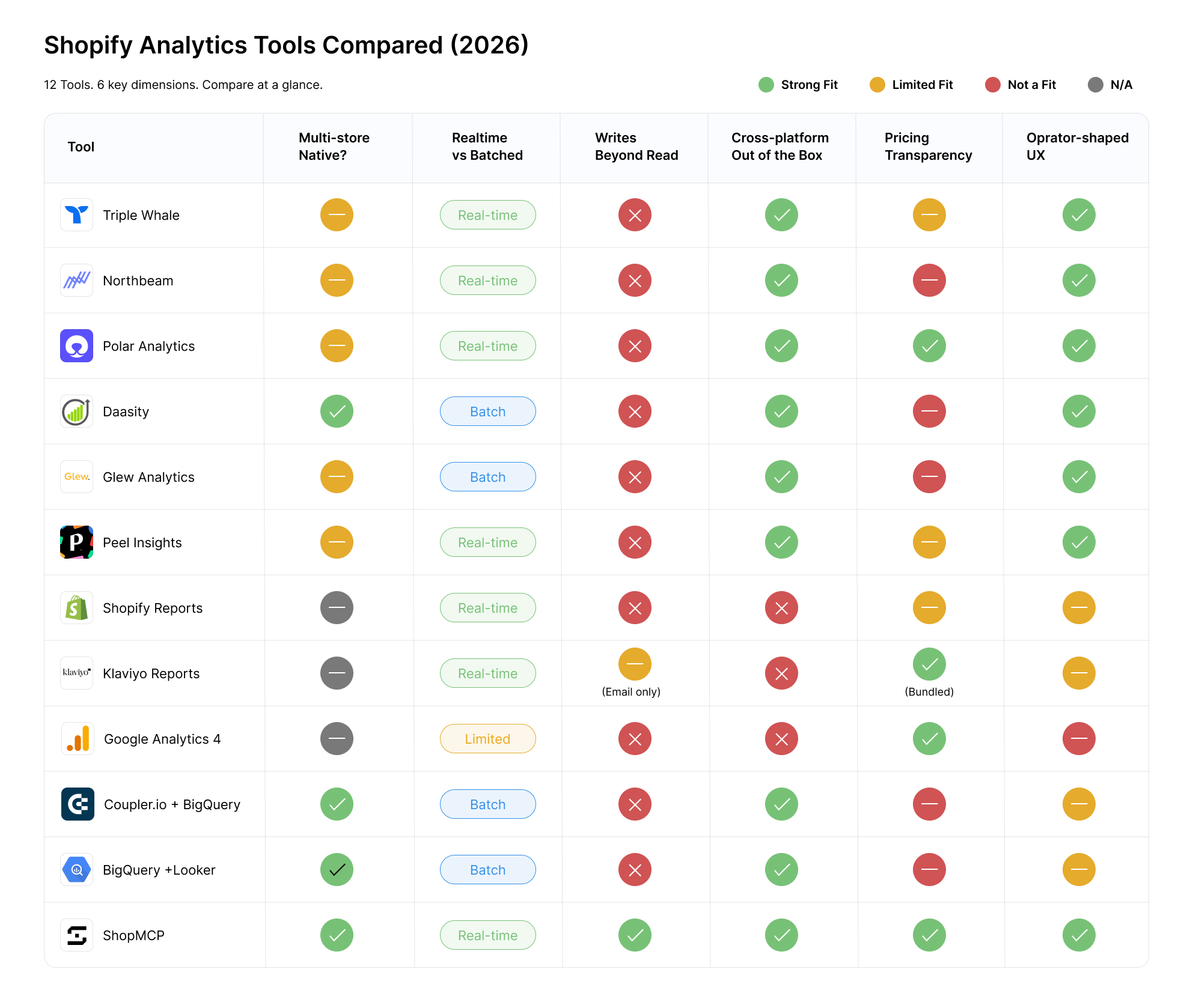
For deeper category framing: Shopify analytics tools compared: 12 options for 2026. For the agency-specific picture: AI for ecommerce agencies: the operator stack. For sister comparisons: Polar Analytics alternatives · Daasity alternatives · Glew alternatives.
Try ShopMCP free → · Read the keystone
Frequently asked questions
What is the best Triple Whale alternative? There is no single best alternative — the right pick depends on the job. Northbeam for serious multi-touch attribution. Polar Analytics for ops-led DTC teams. Daasity or Glew for data warehouse flexibility. Peel Insights for retention and cohorts. ShopMCP for agencies running multiple stores or ops teams who want plain-English access across Shopify, Klaviyo, GA4, and ads.
How does Triple Whale's pricing compare to alternatives? Triple Whale's pricing scales with revenue and historically lands in the higher hundreds to thousands per month for serious users. Polar Analytics and ShopMCP are typically lower-cost; Northbeam, Daasity, and Glew often quote higher. Always check current vendor pricing — analytics tool pricing changes frequently and quote-based pricing can vary by deal.
Is Triple Whale's attribution accurate? Triple Whale's own marketing emphasizes their Sonar pixel for post-iOS-14 attribution. Whether that accuracy is sufficient for your decisions is something only your team can validate against your own data. Multi-touch attribution is intrinsically modeled — every vendor in this space, including Triple Whale, makes assumptions you should understand before betting decisions on the output.
Should an agency use Triple Whale? Triple Whale supports multi-store usage but the UX is dashboard-first and single-tenant-leaning at heart. For agencies running 5-30 client stores who need first-class workspace switching and cross-platform queries (Klaviyo + GA4 + Google Ads + GSC + Stripe alongside Shopify), an operator-layer MCP like ShopMCP is purpose-built for the job. Triple Whale and ShopMCP can also coexist — they solve different problems.
More Articles
Your coffee's still warm. Your Monday review is done.
Connect one platform in 5 minutes. Run your first playbook before the kettle boils.

2026 Copyright © ShopMCP. All rights reserved. A Perceptiv Digital initiative.