
Shopify
StackOne alternatives: when to choose StackOne vs ShopMCP
Date
July 15, 2026
Author
Igor Cerjan
If you're comparing StackOne and ShopMCP, the real question is not "which one has more connectors?"
StackOne is AI-agent integration infrastructure. It gives builders managed connectors, auth, action execution, MCP access, tool discovery, and prompt-injection defense. Their pricing page lists a free Starter plan with 270+ pre-built connectors, 18,000+ actions, managed auth, MCP, an AI action SDK, and 1,000 free action calls each month.
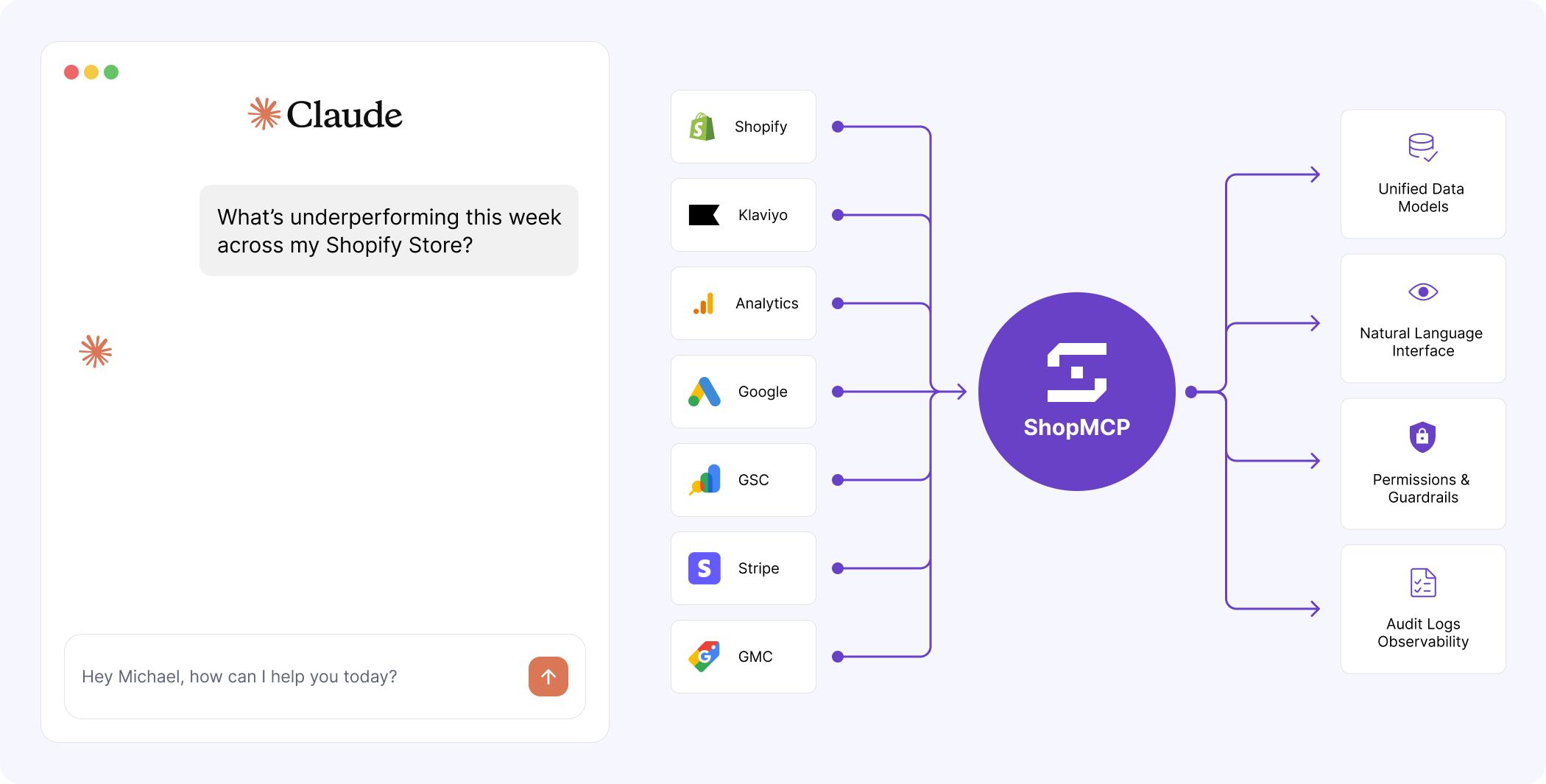
ShopMCP sits one level closer to the operator. It is the commerce MCP layer for people who run ecommerce work in Claude, ChatGPT, Cursor, or another MCP client. The job is not to give a developer every possible SaaS action. The job is to let an ecommerce team ask the trading question and get the answer across storefront, ads, analytics, retention, finance, support, marketplaces, and inventory.
Both products can be good choices. They are built for different moments.
Short answer
Choose StackOne if you are building AI agents and need broad, managed integration infrastructure across many SaaS categories.
Choose ShopMCP if you run ecommerce operations and want Claude or ChatGPT to understand your commerce stack without building your own connector layer, routing system, safety model, and playbook library.
The simplest split:
| Buyer question | Better fit |
| "How do we give our agent access to hundreds of SaaS tools?" | StackOne |
| "How do we make Claude or ChatGPT useful for ecommerce work this week?" | ShopMCP |
What StackOne is good at
StackOne is strong because it knows what developers building agents need.
Its MCP docs say StackOne connects platform actions directly to LLM clients and agents through the Model Context Protocol. That means a team can use StackOne as the managed integration layer instead of wiring auth, API quirks, retries, and action schemas one integration at a time.
The product also tackles context bloat. StackOne's tool discovery page describes a `tool_search` and `tool_execute` pattern: the agent asks for the right action, StackOne narrows the available tool set, then execution happens server-side. That is a smart answer to the problem every MCP-heavy product runs into: once you expose too many tools, the model spends its context remembering the tool catalogue instead of reasoning about the user's problem.
Security is another serious part of their pitch. StackOne Defender is positioned as an open-source library that detects indirect prompt injection in documents, emails, tickets, and other data an agent consumes. Their Shopify MCP page also calls out prompt-injection risk and says Defender scans responses before they enter the agent context.
For a platform team, that is a compelling bundle.
Where ShopMCP is different
ShopMCP does not need to become a generic integration platform to matter.
An ecommerce operator is usually not asking, "Can my agent call any SaaS API?" They're asking:
Why did revenue drop, and is it traffic, conversion, product availability, feed health, ad spend, email revenue, search demand, support load, or payout timing?
That question does not need 18,000 actions. It needs the right commerce sources, the right defaults, and a workflow that knows what a trading review, SKU margin scan, feed-health check, abandoned-flow audit, or agency client intervention should look like.
StackOne gives builders a broad action layer. ShopMCP gives operators a commerce answer layer.
Side-by-side
| StackOne | ShopMCP | |
| Primary buyer | Developers and platform teams building AI agents | Ecommerce operators, agencies, and multi-store teams |
| Main job | Managed connector infrastructure for agents | Commerce MCP layer for Claude, ChatGPT, Cursor, and MCP clients |
| Breadth | 270+ connectors and 18,000+ actions listed on pricing page | Commerce-native integrations across storefront, ads, analytics, retention, finance, support, CRM, marketplaces, and inventory |
| Tool routing | Semantic `tool_search` / `tool_execute` pattern | Commerce playbook routing through `shopmcp_ask`, saved playbooks, and server-side job execution |
| Shopify angle | Shopify MCP server with 85 actions | Shopify operator layer across one store, many stores, and cross-stack workflows with GA4, Klaviyo, ads, finance, feed, marketplace, and support data |
| Best first use | Build an agent that can act across many business systems | Connect first commerce source, then run a strategic prompt in Claude or ChatGPT |
| Writes | Dashboard/action controls and session scoping | Reads by default, workspace write gates, connection scopes, API-key scopes, host-client approval prompts, logs, and commerce-specific write caution |
| Pricing shape | Free Starter plus usage-based calls after included volume | Workspace pricing for ecommerce operators and teams |
Choose StackOne if
You have a developer or platform team building a custom agent.
You need broad SaaS coverage beyond ecommerce: HRIS, CRM, support, docs, project management, finance, and internal tools. StackOne's connector count and action count matter in that buying process.
You want to build your own product experience on top. StackOne gives you the lower-level layer: auth, connectors, execution, discovery, and defense. Your team still owns the agent workflow, user onboarding, ecommerce defaults, commercial logic, and operator-facing playbooks.
Choose ShopMCP if
You want the fastest path from "we connected Shopify" to "we got a useful commerce answer."
You don't want to design tool discovery, tool descriptions, routing, first prompts, playbooks, write gates, multi-store handling, and commerce-specific onboarding yourself. You want Claude or ChatGPT to answer ecommerce questions with the stack you already run.
You care about the operator workflow more than the connector catalogue. Shopify is not useful in isolation if the answer depends on Klaviyo revenue, GA4 conversion, Google Ads spend, Merchant Center disapprovals, Stripe payouts, Amazon listings, eBay orders, Zendesk tickets, or inventory risk.
Can you use both?
Yes.
A technical team could use StackOne as infrastructure for custom AI agents while the ecommerce team uses ShopMCP for commerce operations in Claude, ChatGPT, or Cursor. That is not duplication. One layer helps builders connect agents to apps; the other helps operators reason about the business.
This is especially true inside larger companies. The platform team might need one integration layer for every department. The ecommerce team still needs trading reviews, feed-health prompts, stockout risk, SKU margin checks, campaign-performance joins, and client-ready summaries.
What ShopMCP should learn from StackOne
StackOne exposes two things ShopMCP should take seriously.
First, tool discovery is now part of the product, not just plumbing. ShopMCP already has `shopmcp_ask` and playbook routing. That should become a first-class commerce router: the user asks what they need to know, and ShopMCP picks the right playbook, sources, connected accounts, missing integrations, and next action.
Second, indirect prompt injection deserves product language and product controls. Ecommerce data has plenty of untrusted text: product descriptions, customer notes, reviews, support tickets, marketplace messages, CMS content, and email bodies. System-prompt reminders are not enough. ShopMCP should scan risky tool responses, tag untrusted text clearly, keep write actions preview-first, and block or quarantine high-risk payloads before they reach the host model.
That does not mean copying StackOne feature-for-feature. It means accepting that MCP products now compete on routing and safety, not only integrations.
The market read
StackOne makes ShopMCP's infrastructure story less defensible if we try to be "the MCP connector company." They have more connectors, a developer-first message, a free plan, tool discovery, and a loud safety story.
ShopMCP still has a real place if it owns the commerce operator job.
The page headline should not be "we have integrations too." It should be closer to:
ShopMCP is the commerce layer of your AI workspace.
That is where StackOne is less likely to follow deeply. Their product has to serve every SaaS category. ShopMCP can make sharper ecommerce calls: when to trust contribution profit, when to veto a report because COGS coverage is weak, when a feed issue matters because ads are spending against it, and when a "revenue drop" is actually stock availability.
Frequently asked questions
What is the best StackOne alternative for ecommerce operators?
If the buyer is an ecommerce operator or agency, ShopMCP is the closer fit. StackOne is a strong product for teams building custom AI agents; ShopMCP is built for ecommerce teams that want Claude, ChatGPT, Cursor, or another MCP client to answer commerce questions now.
Are StackOne and ShopMCP direct competitors?
They overlap around MCP and AI-accessible tools, but the level is different. StackOne is integration infrastructure for builders. ShopMCP is an ecommerce operator layer on top of commerce systems, playbooks, and permissioned MCP access.
Does ShopMCP need to copy StackOne's tool search?
No. ShopMCP should build a commerce-native version: route the user to the right playbook, source set, account, missing integration, and next action. Generic action search can come later if the raw tool catalogue starts hurting model context or routing quality.
Does StackOne support Shopify MCP?
Yes. StackOne has a Shopify MCP page that lists 85 actions and discusses context bloat, action limits, and prompt-injection risk. That is a strong infrastructure offering. ShopMCP's Shopify value is the operator layer around Shopify plus the rest of the commerce stack.
Can StackOne and ShopMCP work together?
Yes. A team can use StackOne for custom internal agents and ShopMCP for commerce operations in Claude, ChatGPT, or Cursor.
Related
More Articles
Your coffee's still warm. Your Monday review is done.
Connect one platform in 5 minutes. Run your first playbook before the kettle boils.

2026 Copyright © ShopMCP. All rights reserved. A Perceptiv Digital initiative.