
Shopify
Viktor alternatives: when to choose Viktor vs ShopMCP
Date
July 29, 2026
Author
Igor Cerjan
If you're comparing Viktor and ShopMCP, don't start with the integration count. Start with where the work happens.
Viktor is a managed AI coworker for teams. It lives in Slack today, with Microsoft Teams marked as soon, and it connects to a wide set of business tools. The pitch is simple: message Viktor like a teammate and ask it to pull reports, build dashboards, manage campaigns, research leads, automate workflows, or write code.
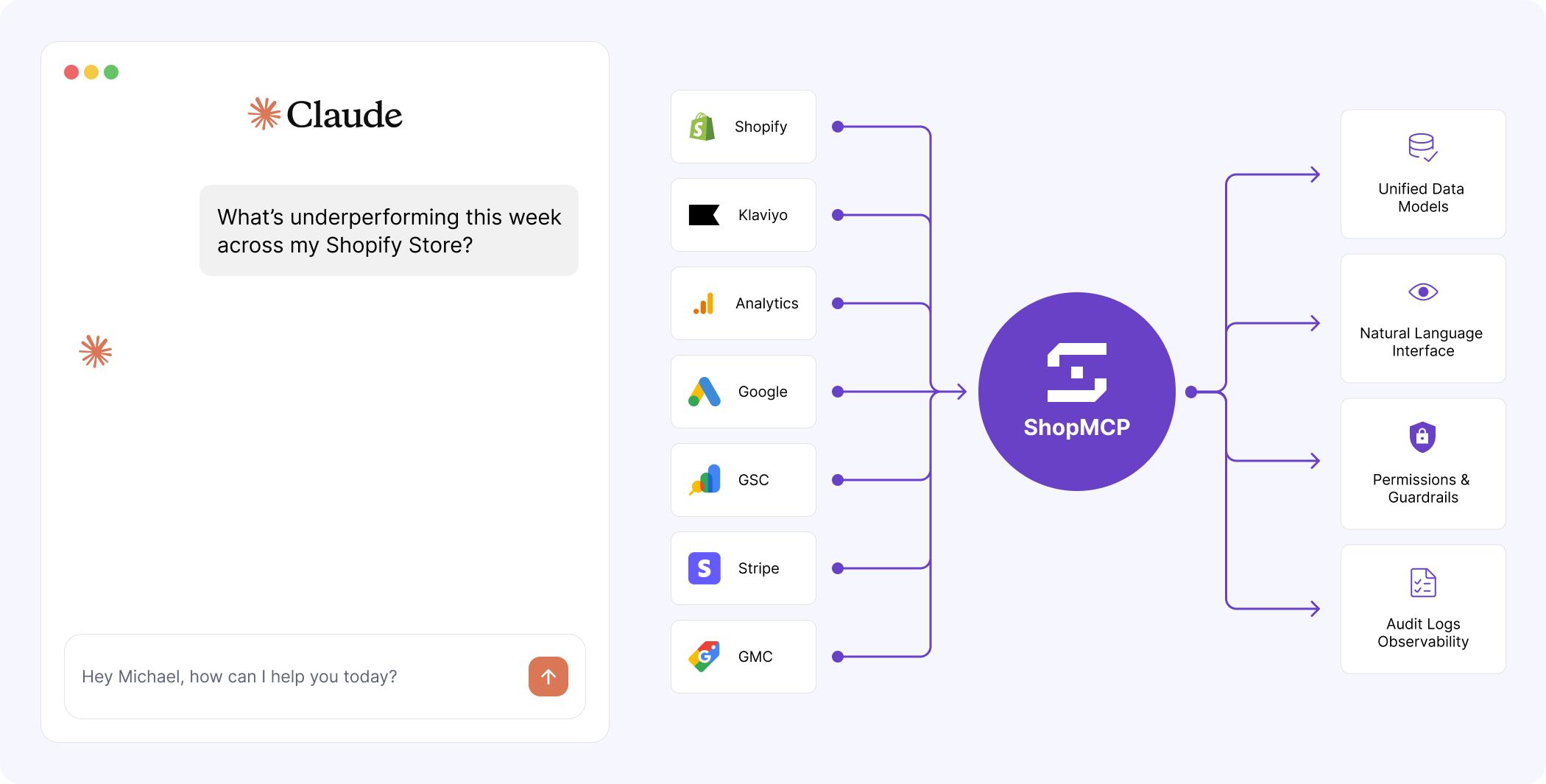
ShopMCP is different. It is the ecommerce MCP layer for the AI assistant you already use: Claude, ChatGPT, Cursor, or any MCP-compatible client. Instead of asking a Slack coworker to do general company work, you give your chosen AI permissioned access to the commerce systems that decide revenue.
Both ideas are valid. They just fit different buyers.
Short answer
Choose Viktor if your company wants a broad AI coworker inside Slack, with a managed connector catalogue and team-wide access from one shared conversation layer.
Choose ShopMCP if your operators already work in Claude or ChatGPT and need deep commerce access: Shopify, BigCommerce, Magento, WooCommerce, Neto, Klaviyo, Attentive, GA4, Search Console, Merchant Center, Google Ads, Meta Ads, TikTok Ads, Stripe, Xero, QuickBooks, HubSpot, Zendesk, Amazon Seller, eBay, Cin7, Unleashed, and more.
The most honest version: Viktor is a horizontal AI coworker. ShopMCP is the commerce tool layer.
What Viktor is good at
Viktor's website does a good job of making the product feel immediate. The homepage offers free credits and no-card signup, while the product page frames Viktor as a coworker that can produce reports, dashboards, spreadsheets, presentations, code commits, deployed apps, and browser work. Their integrations page claims 27 native integrations plus access to thousands of managed tools.
That breadth matters. A CEO, ops manager, marketer, finance lead, and support manager can all imagine using the same assistant in Slack.
Viktor also sells the managed angle well. Their comparison pages argue against DIY tools, generic chatbots, and one-off Slack bots. The security page lists SOC 2 Type 1, GDPR alignment, CCPA, CASA Tier 3, encrypted credentials, isolated execution, approval flows, and no customer-data training.
For a Slack-first team that wants one broad AI coworker, that is compelling.
Where ShopMCP is different
ShopMCP doesn't need to be the coworker in the room. It needs to be the commerce system the coworker, operator, or AI client can trust.
That difference sounds small until you look at the daily use case. A head of ecommerce usually isn't asking a general assistant, "Can you help with business?" They're asking something more specific:
Why did revenue drop this week, and is it product, traffic, campaign, inventory, email, search, or support?
That question needs commerce context. It needs store data, ad data, analytics data, retention data, marketplace data, finance data, and sometimes support tickets or inventory. It also needs the answer inside the AI tool the operator already uses.
ShopMCP's job is to make Claude or ChatGPT useful for that moment.
Side-by-side
| Viktor | ShopMCP | |
| Primary surface | Slack today; Microsoft Teams marked as soon | Claude, ChatGPT, Cursor, and MCP-compatible clients |
| Main idea | Managed AI coworker for the whole company | Commerce MCP layer for ecommerce operators |
| Best buyer | Slack-first teams that want broad delegation | Ecommerce brands, agencies, and multi-store operators |
| Integration shape | Broad business connector catalogue | Commerce-native integrations across storefront, ads, analytics, retention, finance, support, marketplaces, and inventory |
| Scheduling | Viktor has recurring task language | Use native Claude/ChatGPT scheduled tasks; playbooks can tell the host AI what to run |
| Files and outputs | Viktor advertises PDFs, spreadsheets, decks, code, apps | Host AI can produce files; ShopMCP provides the live commerce context and playbook instructions |
| Write safety | Viktor describes approval systems | ShopMCP adds workspace controls, scoped API keys, connection scopes, write toggles, logs, and native host-client approvals |
| Best first prompt | "Ask Viktor to do a business task" | "Run my first strategic trading review across the commerce stack" |
Choose Viktor if
Your team already lives in Slack and you want AI to feel like another teammate in the channel.
You want a broad assistant across many departments: sales, finance, product, engineering, support, operations, and marketing. Ecommerce may be one of the jobs, but it isn't the only job.
You want a managed product that hides setup details from non-technical teammates. Viktor's "no workflow builder" message is strong here; the buyer doesn't want to learn agents, MCP, schemas, or tool routing.
Choose ShopMCP if
You already use Claude or ChatGPT for real work and don't want to move the operating surface into Slack.
You care more about ecommerce depth than horizontal breadth. The question isn't "can the AI connect to a lot of apps?" The question is whether it can reason across the systems that decide sales: products, orders, ad spend, flows, search queries, feed issues, payouts, support load, inventory, and marketplace status.
You run multiple stores, client workspaces, or brands. Generic team-wide access can get awkward when the real requirement is tenant boundaries, connection-level access, scoped keys, and per-workspace controls.
You want writes to stay off until the team deliberately turns them on. Claude and ChatGPT already gate sensitive tool calls natively; ShopMCP adds the commerce-side controls below that layer.
Can you use both?
Yes, and in some teams that will be the cleanest setup.
Use Viktor as the broad company assistant in Slack. Use ShopMCP as the commerce MCP layer for operators who live in Claude, ChatGPT, or Cursor. The Slack assistant can help coordinate the work; the commerce operator still needs a deep, permissioned way to inspect store, ad, analytics, finance, and marketplace systems.
That is not duplication. It is two layers of the AI workspace.
The market read
Viktor validates the category. Buyers are moving away from "AI that answers questions" and toward "AI that can operate tools." That is good for ShopMCP, not bad.
The risk is story clarity. Viktor's story is easy to repeat: AI coworker in Slack. ShopMCP has to be just as clear:
ShopMCP connects your ecommerce stack to Claude or ChatGPT.
Everything else should support that sentence.
Frequently asked questions
What is the best Viktor alternative for ecommerce operators?
If the job is ecommerce operations inside Claude, ChatGPT, Cursor, or another MCP client, ShopMCP is the closest fit. If the job is a broad AI coworker in Slack, Viktor is the one to evaluate.
Are Viktor and ShopMCP direct competitors?
They overlap around AI-assisted operations, but they sit in different places. Viktor is a team-facing AI coworker. ShopMCP is a commerce-native MCP layer.
Does ShopMCP need to build scheduling to compete with Viktor?
No. Claude and ChatGPT already support scheduled tasks. ShopMCP playbooks should tell the host AI what to run, what sources to query, and what output shape to produce.
Does ShopMCP need to create PDFs, docs, and CSVs?
Usually no. Claude and ChatGPT can produce those files when asked. ShopMCP should supply the live commerce context, evidence, and instructions. The host AI can format the output.
What should I try first in ShopMCP?
Connect your first commerce source, then paste the suggested first prompt into Claude or ChatGPT. After you connect more sources, use cross-stack prompts like Shopify + GA4 trading review, Shopify + Klaviyo retention review, or Shopify + Google Ads wasted-spend review.
Related
More Articles
Your coffee's still warm. Your Monday review is done.
Connect one platform in 5 minutes. Run your first playbook before the kettle boils.

2026 Copyright © ShopMCP. All rights reserved. A Perceptiv Digital initiative.